Hiring Signals for Recruitment Agencies: 15 Signals to Track in 2026
Hiring signals for recruitment agencies are observable events or patterns that suggest recruitment demand may exist, increase or develop inside a company.
Agencies track them because timing matters. A static company database tells you which companies exist and broadly fit your market. Hiring signals help you identify where something may be changing.
But a hiring signal is not the same as buying intent.
A vacancy shows that a company is hiring. It does not prove that the company needs external recruitment support. A funding announcement may suggest future growth. It does not mean an agency brief is coming.
The practical sequence is:
Signal → Research → Qualification → Prioritization → Outreach
Signals tell you where to investigate, not automatically who will buy.
That distinction is central to effective signal-based prospecting.
What Are Hiring Signals for Recruitment Agencies?
A hiring signal is observable evidence that a company may be entering, expanding or struggling with a hiring requirement that could become relevant to a recruitment agency.
Several related concepts should not be confused:
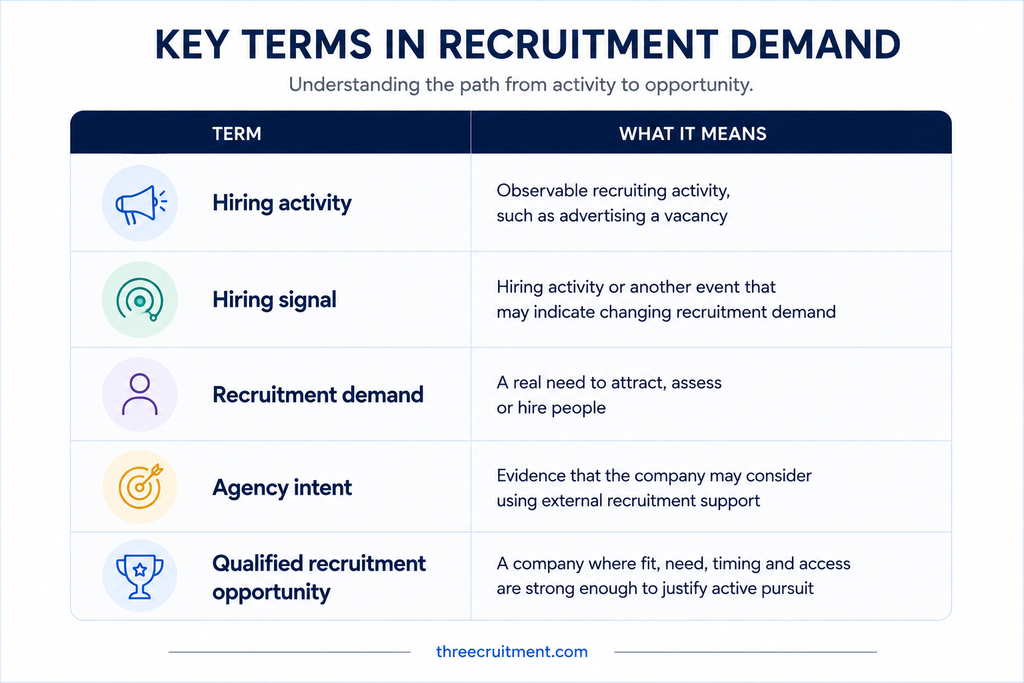
These stages are related, but they are not interchangeable.
A job posting is evidence of hiring activity.
Hiring activity can become a useful signal.
A signal combined with context creates a recruitment-demand hypothesis.
Only after qualification can that hypothesis become a potential commercial opportunity.
Why Hiring Signals Matter
Recruitment prospecting often starts with static information:
- industry
- location
- company size
- technologies
- estimated headcount
- job titles
- decision-makers
That information helps define who could theoretically become a client.
Hiring signals add the timing layer.
They can help an agency identify:
- companies entering a new hiring cycle;
- accounts where demand appears to be increasing;
- roles that align with the agency’s specialism;
- previous clients becoming commercially relevant again;
- hiring situations that deserve deeper research;
- accounts that should move ahead of lower-priority prospects.
This improves more than list building.
It gives recruiters a reason to investigate an account now rather than six months from now.
It can also create better outreach context. There is a significant difference between approaching a company because it happens to fit your ICP and approaching it because it fits your ICP and has just opened several difficult-to-fill roles in your specialist market.
Hiring signals are therefore best treated as a prioritization layer inside a broader lead generation for recruitment agencies system.
The Four Main Types of Hiring Signals
For practical recruitment agency prospecting, most useful signals fall into four categories.
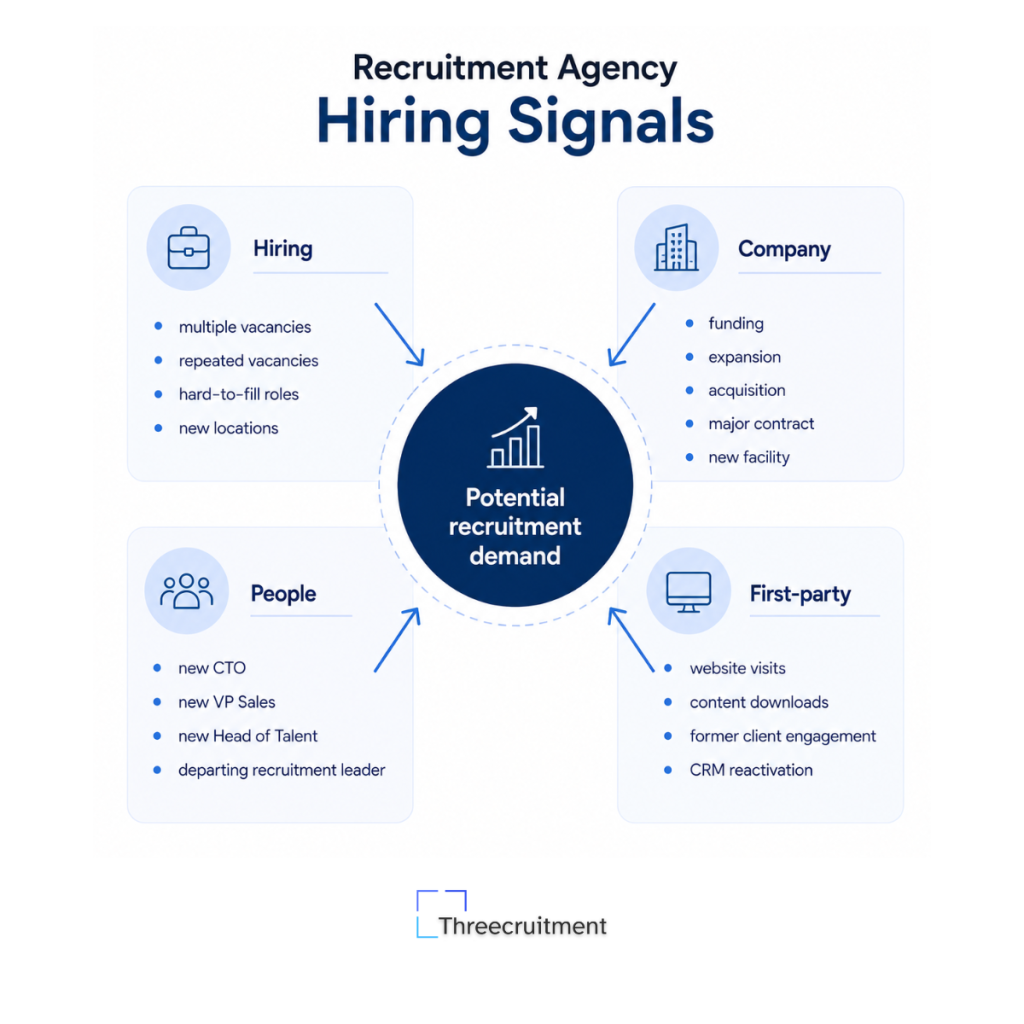
Hiring Activity Signals
Hiring activity signals are the most direct because they come from visible recruitment activity.
Examples include:
- multiple relevant vacancies;
- repeated or reposted roles;
- specialist vacancies;
- several positions within one department;
- hiring acceleration;
- expansion into a new hiring location;
- roles remaining open over time.
Suppose a cybersecurity recruitment agency sees a target company advertise one junior finance vacancy.
That is hiring activity, but probably irrelevant.
If the same company suddenly advertises a Security Engineer, SOC Analyst, Cloud Security Architect and Head of Information Security, the pattern becomes commercially more interesting.
The agency should still verify:
- whether the roles are genuinely active;
- how recently they were published;
- whether they fall inside its specialism;
- whether internal TA is handling them effectively;
- whether external suppliers are already involved;
- whether the volume represents unusual activity for that company.
Repeated vacancies also need interpretation.
A role that appears several times may indicate recruitment difficulty. It could also be an evergreen position, an automated repost or an intentionally persistent talent pipeline.
The signal creates a question. It does not answer it.
Company Signals
Company events can create conditions that lead to future recruitment demand.
Useful examples include:
- investment or funding;
- entry into a new geography;
- opening an office or facility;
- acquisitions;
- major customer contracts;
- product launches;
- creation of a new business unit;
- announced expansion plans.
The mistake is treating the event itself as recruitment intent.
Funding alone is not recruitment intent.
A company may raise capital to refinance debt, acquire technology, invest in product development or extend runway without materially increasing headcount.
Instead, investigate what the company says the investment is for.
A funding announcement combined with explicit expansion plans is more relevant.
Funding combined with expansion and several newly published specialist vacancies is more relevant again.
The event becomes useful when it contributes to a plausible recruitment-demand hypothesis.
People Signals
Leadership changes can precede changes in hiring priorities, team structure and supplier relationships.
Examples include:
- new C-level executive;
- new VP of Sales;
- new HR Director;
- new Head of Talent;
- new VP Engineering;
- new departmental leader;
- departure of internal recruiters;
- changes in recruitment leadership.
A newly appointed department leader may inherit open headcount or receive a mandate to build a team.
A new Head of Talent may reconsider existing recruitment suppliers.
A departure from the internal TA team may temporarily reduce recruitment capacity.
None of those outcomes should be assumed.
The useful question is:
What could this leadership change alter about the company’s hiring requirements or its ability to deliver recruitment internally?
A leadership appointment becomes stronger when it aligns with additional evidence.
For example:
New VP Engineering + several engineering vacancies + expansion into a new product area
is more useful than:
New VP Engineering
in isolation.
First-Party and Relationship Signals
Some of the strongest recruitment prospecting signals already exist inside an agency’s own network or CRM.
Examples include:
- a former client starts hiring again;
- a previous prospect begins advertising relevant roles;
- an old account re-enters a growth cycle;
- a past hiring manager moves to another company;
- a former candidate becomes a manager;
- a referral reveals an upcoming hiring requirement;
- a past prospect engages with relevant content;
- previous conversations indicate future workforce plans.
These signals matter because they combine market context with relationship context.
A company you already know can often be easier to interpret than a completely cold account.
Instead of asking only:
Who is hiring?
your CRM may reveal a better question:
Who do we already know that has become commercially relevant again?
Weak Signals vs Stronger Signal Combinations
This is where hiring-signal analysis becomes useful.
An isolated signal is usually weak.
Weak
Funding announcement
Possible interpretation: The business has additional capital.
Unknown: Whether any meaningful hiring will follow.
Better
Funding + announced hiring expansion
Possible interpretation: New capital may support workforce growth.
Stronger
Funding + announced expansion + several specialist vacancies
Possible interpretation: Relevant hiring demand is becoming visible.
More Actionable
Funding + expansion + repeated specialist vacancies + limited visible internal TA capacity + identifiable decision-maker
Possible interpretation: The company may have both recruitment demand and a potential delivery gap worth investigating.
The principle is simple:
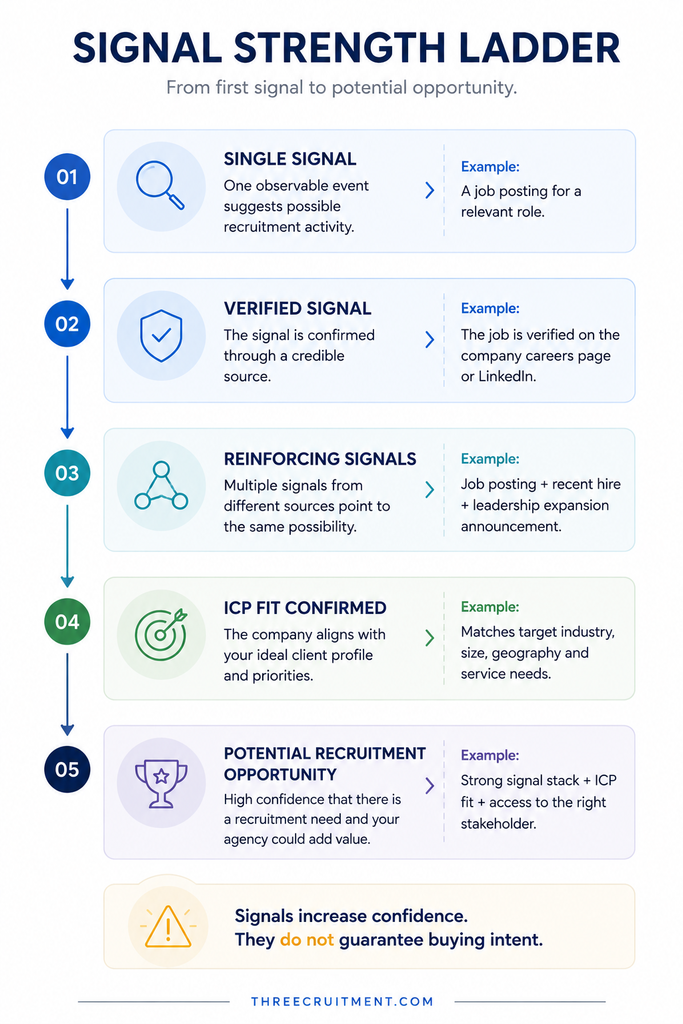
Signal strength increases when several independent pieces of evidence reinforce the same recruitment-demand hypothesis.
This does not mean combining four signals creates a guaranteed lead.
It increases confidence that the account deserves attention.
A useful mental model is:
Single signal → verified signal → reinforcing signals → ICP fit confirmed → potential recruitment opportunity
Signals increase confidence. They do not guarantee buying intent.
15 Hiring Signals Recruitment Agencies Should Monitor
| Signal | What It May Indicate | What to Check Next |
|---|---|---|
| Multiple relevant vacancies | Increased hiring demand | Are roles recent and relevant to your niche? |
| Reposted roles | Possible difficulty filling positions | Is the role genuinely reopened or automatically reposted? |
| Long-running vacancies | Potential sourcing challenge | How long has the position actually been active? |
| Specialist hiring | Harder-to-source talent requirement | Does your agency have a genuine delivery advantage? |
| Sudden hiring acceleration | New growth or workforce demand | Is this unusual compared with normal hiring levels? |
| Funding linked to expansion | Potential future headcount growth | What does the company say the capital will fund? |
| Geographic expansion | New local hiring requirements | Which functions will be built in the new location? |
| New facility or office | Possible workforce buildout | Is recruitment already underway? |
| Major client contract | Additional delivery capacity may be needed | Does the contract require new headcount? |
| New functional leader | Team building or restructuring may follow | What mandate has the new leader been given? |
| New Head of Talent | Recruitment strategy or supplier changes | Is the company changing its hiring model? |
| Reduced internal TA capacity | Possible delivery gap | Has hiring demand remained stable while TA capacity fell? |
| Former client hiring again | Relationship reactivation opportunity | Are the roles relevant to previous work? |
| Previous prospect becoming active | New timing for an old account | What changed since the last conversation? |
| Repeated hiring in one function | Sustained departmental growth | Is hiring volume large enough to create external need? |
The objective is not to monitor everything.
An engineering recruiter may care deeply about manufacturing facility expansion. A SaaS sales recruiter may care more about new CRO appointments, market entry and sales-team buildouts.
Choose signals that logically connect to your niche.
How to Avoid False Positives
Signal-based recruitment prospecting becomes expensive when everything is treated as an opportunity.
False positives are inevitable. The solution is verification.
Evergreen Jobs
Some companies continuously advertise roles because they hire the same profile throughout the year.
A recurring job may therefore represent normal workforce activity rather than unusual recruitment pressure.
Stale Job Listings
A vacancy displayed on a job board may no longer reflect an active requirement.
Check the company’s own career page where possible and compare publication dates across sources.
Automatically Reposted Jobs
Job distribution can be automated through ATS and job-board integrations. LinkedIn, for example, supports ATS integrations that can automatically ingest jobs from employers’ systems. LinkedIn also allows employers to repost jobs after closing them.
A fresh timestamp therefore does not always mean a completely new vacancy.
Large Internal TA Teams
A multinational may advertise 100 relevant roles and still be a poor agency prospect because it has a mature internal recruitment organization, direct sourcing capabilities and established suppliers.
Hiring volume and agency need are different variables.
Funding Without Hiring
Capital does not automatically become headcount.
Verify whether hiring, geographic expansion or organizational growth is actually part of the stated plan.
Irrelevant Leadership Changes
A new CFO is not automatically a useful signal for an engineering recruitment agency.
Leadership changes matter when they connect logically to your specialism or recruitment decision-making.
Old Announcements
A six-month-old expansion announcement may no longer provide useful timing.
Always record when the signal occurred, not only when you discovered it.
Hiring Outside Your Niche
Twenty vacancies are commercially irrelevant if none match what your agency can credibly deliver.
Before prioritizing a signal, verify:
Recency + Relevance + Repetition + ICP Fit + Role Difficulty + Internal TA Capacity + Source Quality
Where to Find Hiring Signals
You do not need an elaborate technology stack to begin.
Company Career Pages
Career pages are often the best source for confirming whether vacancies are genuinely active.
Look beyond total vacancy count.
Check:
- role families;
- locations;
- seniority;
- repetition;
- concentration inside particular teams.
LinkedIn can reveal:
- company vacancies;
- new leadership appointments;
- departmental growth;
- hiring announcements;
- employee movements;
- relevant decision-makers.
Remember that jobs can also be distributed through integrations and reposted, so use LinkedIn as evidence rather than unquestioned truth.
Job Boards
Job boards are useful for pattern detection.
A single posting may tell you little. Multiple related positions across a short period can justify deeper investigation.
Google Search, Google News and Alerts
Use boolean search for combinations such as:
- “[company] expansion”
- “[company] hiring”
- “[company] new office”
- “[company] contract”
- “[company] funding”
- “[company] acquisition”
Google Alerts can also notify you when new search results appear for selected topics or companies.
Company Announcements and Press Releases
Primary company announcements are particularly useful for verifying:
- investment;
- market entry;
- new facilities;
- acquisitions;
- major contracts;
- leadership appointments.
Whenever possible, verify a commercial news article against the company’s original announcement.
Funding Databases and Industry Publications
These can help with discovery, particularly in venture-backed sectors.
Again, funding is the beginning of the research process, not the conclusion.
CRM and Historical Data
Your own records may contain:
- previous hiring cycles;
- supplier discussions;
- old proposals;
- lost opportunities;
- former clients;
- hiring-manager relationships;
- reasons an account did not progress.
Historical context often makes public signals far more useful.
Former Clients and Professional Networks
Conversations can reveal signals before they become searchable.
Candidates, clients, former colleagues and industry contacts may know that a team is growing, a manager has left or a hiring project is approaching.
Treat relationship intelligence carefully and verify where appropriate.
How to Prioritize Accounts Using Hiring Signals
A company can show high hiring activity and still be a poor prospect.
That is why Threecruitment separates fit from intent.
Threecruitment Fit × Intent Matrix
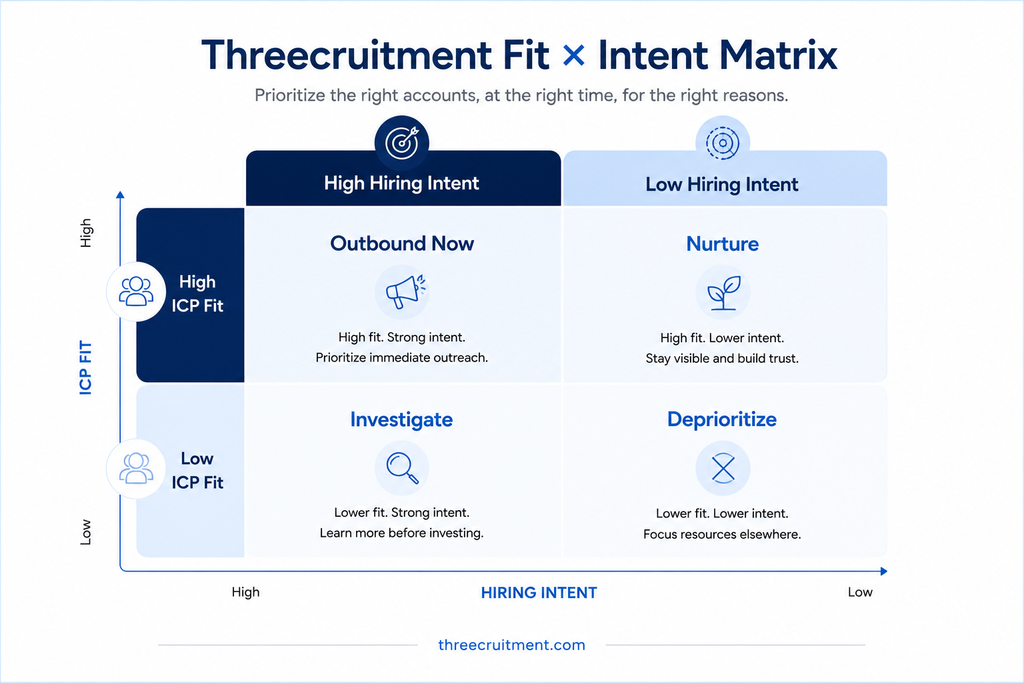
Hiring signals primarily inform the intent side of the matrix.
ICP analysis determines fit.
High Fit + High Intent: Outbound Now
Example:
A specialist engineering recruiter identifies a manufacturing company inside its core geography that has opened six controls-engineering roles, recently announced a facility expansion and has limited visible internal TA capacity.
Research the account and start a relevant conversation.
High Fit + Low Intent: Nurture
Example:
A perfect target company fits your niche and company-size criteria but currently has almost no relevant recruitment activity.
Keep the account visible rather than forcing outreach around a weak trigger.
Low Fit + High Intent: Investigate
Example:
A company is hiring aggressively, but most vacancies sit outside your specialism.
There may be an angle worth investigating, but hiring volume alone should not move it to the top of your list.
Low Fit + Low Intent: Deprioritize
Example:
The company sits outside your preferred market and shows little relevant hiring activity.
Your time is probably better spent elsewhere.
For a deeper framework on defining and identifying the right target companies, see how to find clients for a recruitment agency.
Build a Simple Hiring Signal Tracking System
A spreadsheet or CRM is enough if the structure helps someone make a decision.
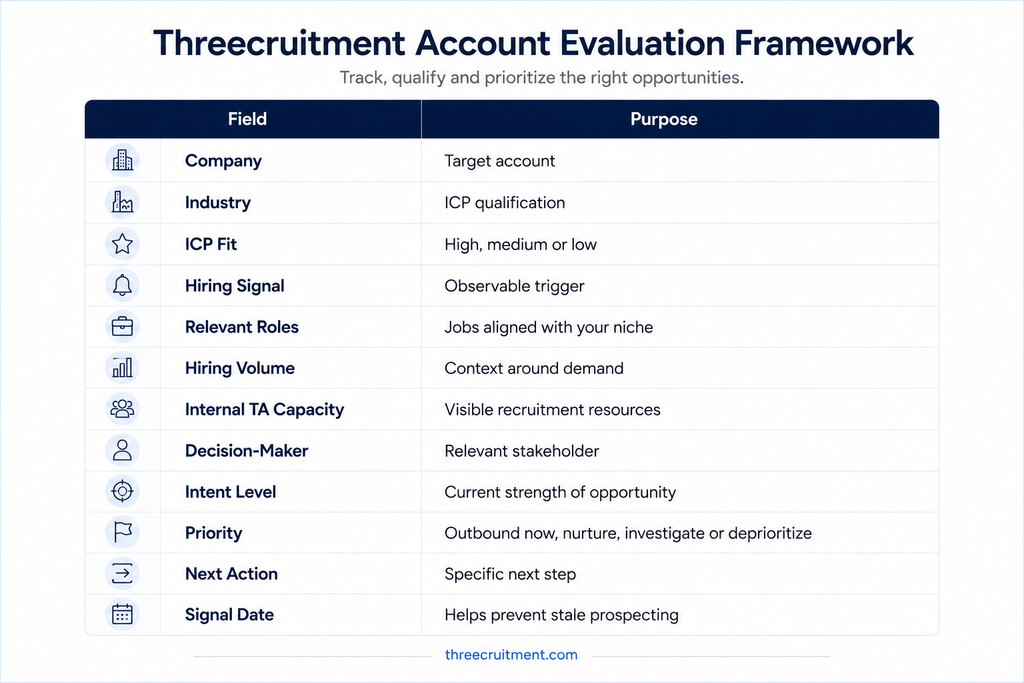
The most important fields are often the least glamorous.
Signal Date
A signal without a date becomes stale intelligence.
Relevant Roles
Do not simply record “12 vacancies.”
Record whether those vacancies overlap with what your agency actually recruits.
Internal TA Capacity
Visible recruitment resources do not tell you exactly how a company operates, but they can provide context.
A company with ten internal recruiters presents a different hypothesis from a similarly sized company with one HR generalist managing the same hiring volume.
Decision-Maker
A strong account signal is less actionable if nobody can identify the person who influences the recruitment decision.
Next Action
Every researched signal should eventually become an action or be deprioritized.
Examples:
- research CTO;
- verify role on career page;
- call former contact;
- nurture for 60 days;
- move to outbound;
- close as irrelevant.
Do not build a database of interesting facts nobody acts on.
From Hiring Signal to Outreach
Hiring signals should improve outreach context, not become an excuse for generic prospecting.
Use:
Signal → Verify → Qualify → Identify Stakeholder → Outreach
A weak approach looks like this:
I saw you’re hiring. We are a recruitment agency and would love to help.
It proves that you found a vacancy. It says almost nothing about why the company should speak with you.
A more relevant illustrative approach could be:
I noticed your team has opened several embedded-software roles in Ljubljana, including two that appear to have been active for some time. We recruit specifically across embedded and firmware engineering in the region, so I thought it was worth asking whether those searches are fully covered internally or whether you’re open to external support on the harder profiles.
This is still only an example.
It is not a guaranteed-performing template.
The improvement comes from the reasoning behind it:
- a specific observable signal;
- relevance to the agency’s niche;
- evidence of potential recruitment difficulty;
- no assumption that the company wants an agency;
- a question that tests the hypothesis.
Common Hiring Signal Mistakes
Treating Every Vacancy as a Lead
A vacancy proves hiring activity, not external agency demand.
Treating Funding as Automatic Intent
Funding creates a research trigger, not a recruitment brief.
Ignoring ICP Fit
The strongest hiring signal in the wrong market can still be commercially useless.
Using Stale Data
Signals decay.
Always record when something happened.
Failing to Verify the Source
Where possible, confirm job-board information against company career pages or primary announcements.
Ignoring Internal TA Capacity
Hiring demand can be real while external recruitment demand remains low.
Looking at One Signal in Isolation
Signal combinations generally create a stronger hypothesis than single events.
Automating Outreach Too Early
Automation can scale bad qualification faster than good qualification.
Verify what happened before building messaging around it.
Collecting Signals Without Defining a Next Action
A signal database is not a sales pipeline.
Every priority account needs a clear next step.
A Simple Weekly Hiring Signal Workflow
The exact cadence depends on your market, team and hiring velocity.
One simple structure is:
Monday: Collect
Capture new vacancies, company events, leadership changes and first-party signals.
Tuesday: Verify and Qualify
Remove stale or irrelevant signals. Check ICP fit, role relevance, recency and internal TA context.
Wednesday: Prioritize
Place accounts into:
- Outbound Now
- Nurture
- Investigate
- Deprioritize
Thursday: Research and Engage
Identify appropriate stakeholders and begin relevant outreach to the highest-priority accounts.
Friday: Review
Update signal status, responses, new information and next actions.
The cadence is illustrative.
What matters is creating a repeatable process that prevents signals from becoming another unused spreadsheet.
Summary
Hiring signals for recruitment agencies are prioritization inputs, not buying-intent guarantees.
The wrong question is:
Who is hiring?
That question produces enormous lists.
The better question is:
Which companies fit our agency, show relevant evidence of recruitment demand, and give us a credible reason to start a conversation now?
That requires more than a vacancy.
Use hiring signals to develop and test a hypothesis.
Look for reinforcing evidence.
Verify the timing.
Check whether the roles fit your specialism.
Understand the likely recruitment challenge.
Identify who matters inside the account.
Then decide whether outreach is justified.
The strongest potential opportunities usually sit where four variables overlap:
Fit + Need + Timing + Access
Turn hiring signals into qualified opportunities
Threecruitment helps recruitment agencies identify the right accounts, prioritize relevant hiring signals and build systematic outreach around companies with stronger recruitment potential.
Turn hiring signals into qualified opportunities
See How Threecruitment Works
Frequently Asked Questions
What are hiring signals for recruitment agencies?
Hiring signals are observable events or patterns that may indicate current or developing recruitment demand inside a company. Examples include multiple vacancies, repeated specialist roles, expansion, leadership changes and renewed hiring activity from former clients.
A signal identifies where an agency should investigate. It does not prove that the company needs external recruiters.
What are the strongest hiring signals?
The strongest signals usually combine several pieces of relevant evidence rather than relying on one event.
For example, repeated specialist vacancies combined with company expansion, limited internal recruitment capacity and strong ICP fit can create a more credible opportunity hypothesis than a funding announcement alone.
Is a job posting a hiring signal?
Yes. A job posting is evidence that a company is hiring for a particular position.
However, it does not prove that the company needs recruitment agency support. Agencies should verify the role, its recency, relevance, difficulty, hiring context and internal recruitment capacity.
Does funding mean a company needs recruiters?
No.
Funding can support hiring, but companies raise capital for many reasons. Recruitment agencies should look for additional evidence such as explicit expansion plans, new vacancies, team growth or new locations before treating funding as a meaningful recruitment prospecting signal.
How can recruitment agencies find companies that are hiring?
Agencies can monitor company career pages, LinkedIn, job boards, company announcements, Google Search, Google News, funding sources, industry publications, CRM data, former clients and professional networks.
The objective is not simply to find companies hiring, but to identify hiring activity relevant to the agency’s niche.
What is the difference between a hiring signal and recruitment intent?
A hiring signal is evidence that recruitment demand may exist or be developing.
Recruitment intent is stronger evidence that a company may consider external recruitment support.
A vacancy can be a hiring signal while the company still intends to fill the role entirely through its internal team.
How recent should a hiring signal be?
There is no universal expiry period.
Recency should reflect the type of signal and the hiring cycle. A job posted yesterday may deserve immediate investigation, while an expansion announcement from several months ago may still matter if hiring connected to that expansion is only beginning.
Always record the signal date and verify whether it is still relevant.
How should recruitment agencies track hiring signals?
A simple CRM or spreadsheet can work.
Track the company, ICP fit, signal, signal date, relevant roles, hiring volume, internal TA capacity, decision-maker, intent level, priority and next action.
The system should help recruiters prioritize accounts, not simply store information.
Can hiring-signal detection be automated?
Parts of it can.
Alerts, job monitoring, company-news tracking, CRM updates and basic classification can be automated.
Human judgment is still useful for determining whether the signal is genuine, whether it fits the agency’s niche and whether the evidence supports a credible recruitment-demand hypothesis.

Author
Edmond Široka
Founder @ Threecruitment
Edmond has spent more than a decade working across recruitment, HR, sales and business development. His experience includes agency recruitment, in-house talent acquisition, HR leadership and running a recruitment business. Today, he focuses on building practical client acquisition systems for recruitment agencies.