How to Find Clients for a Recruitment Agency in 2026: Step-by-step guide
If you want to know how to find clients for a recruitment agency, do not start by buying a database or scraping thousands of companies with open jobs.
Start with a narrower process:
ICP definition → hiring signals → qualification → decision-maker identification → prioritization
A company advertising a vacancy is hiring. That does not automatically mean it needs an external recruitment agency.
The stronger opportunity is usually a company that fits your market, has a recruitment problem you can genuinely solve, shows evidence that the problem matters now, and gives you access to someone capable of acting on it.
That distinction changes recruitment prospecting from list building into opportunity identification.
This guide explains how to find those companies, evaluate their signals, identify the right stakeholders and build a prospect list based on likelihood of opportunity rather than database size.
What Makes a Company a Good Recruitment Prospect?
A useful recruitment prospect is more than a company name attached to an open vacancy.
It helps to separate four terms that are often treated as interchangeable:
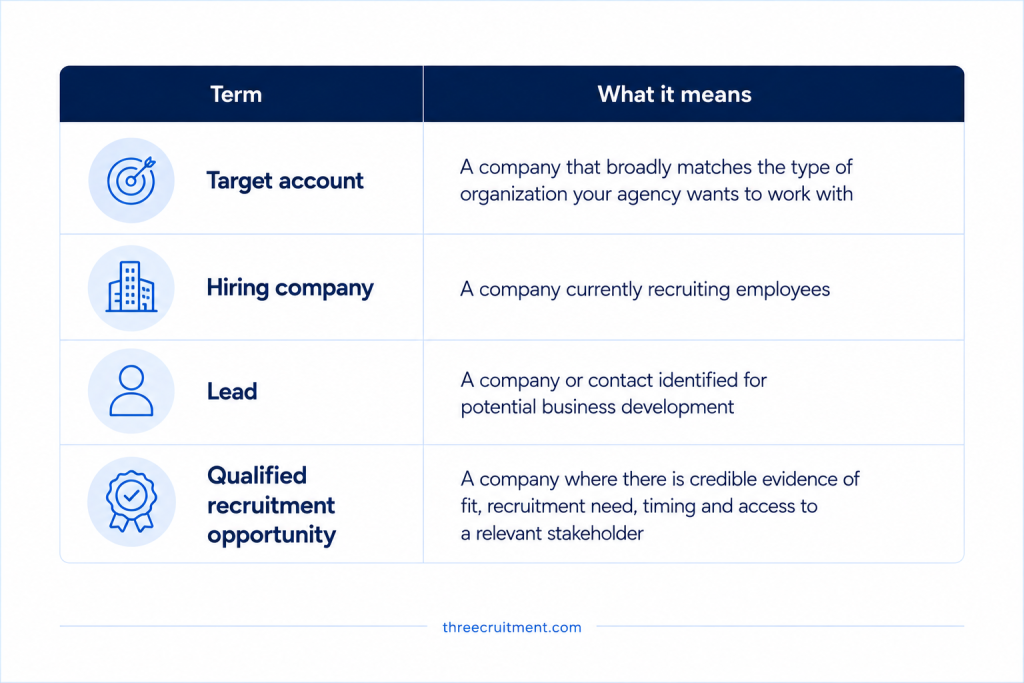
What makes a good recruitment prospect?
A good recruitment prospect is a company that matches the agency’s ideal client profile, shows evidence of a recruitment problem the agency can solve, has current or emerging hiring urgency, and provides access to a relevant decision-maker.
At Threecruitment, we use a simple practical model for evaluating this:
Fit + Need + Timing + Access
It is a prospecting framework, not an empirical industry benchmark.
Fit
Does the company match the type of client your agency can serve effectively?
Look at:
- industry;
- company size;
- geography;
- roles being hired;
- your specialization;
- recruitment model;
- potential fee value;
- potential repeat business.
Need
Is there evidence that the company has a recruitment problem worth solving?
Examples include:
- specialist roles that are difficult to fill;
- several vacancies competing for internal recruitment capacity;
- repeated attempts to hire the same profiles;
- expansion into a talent market the employer does not know well;
- urgent project hiring;
- limited access to niche candidates.
Timing
Why could recruitment support become relevant now?
Possible timing signals include:
- new vacancies;
- roles being reposted;
- a sudden increase in hiring;
- expansion announcements;
- funding tied to hiring plans;
- new projects;
- acquisitions;
- leadership changes;
- office or facility openings;
- major commercial contracts.
Access
Can you identify someone close enough to the problem to have a useful conversation?
Depending on the organization, that might be a:
- Founder;
- CEO;
- CTO;
- VP Engineering;
- Head of Talent;
- Talent Acquisition Lead;
- HR Director;
- Hiring Manager;
- functional department leader.
Consider a specialist software recruitment agency targeting a 300-person SaaS company.
The company fits its niche. It has six engineering vacancies. Two specialist roles have been repeatedly advertised. Its internal talent team appears small, and a new VP Engineering has recently joined.
That is substantially more interesting than simply knowing that the company has jobs advertised.
For the broader system around ICPs, outbound channels, referrals and client acquisition, see our guide to lead generation for recruitment agencies.
Why Hiring Does Not Automatically Mean Recruitment Demand
One of the easiest mistakes in recruitment agency prospecting is treating every vacancy as a sales trigger.
A job advertisement proves one thing:
The company wants to hire somebody.
It does not prove:
- the role is difficult to fill;
- the employer needs external support;
- internal Talent Acquisition lacks capacity;
- budget exists for an agency;
- the company works with agencies;
- the hiring manager is dissatisfied with direct applications;
- the vacancy is urgent;
- the role is relevant to your specialization.
Compare two fictional companies.
Company A: hiring, but weak agency intent
Company A has:
- one junior marketing vacancy;
- a sizeable internal Talent Acquisition team;
- a vacancy published five days ago;
- a common candidate profile;
- no obvious urgency;
- no evidence of repeated hiring difficulty.
There is hiring activity.
But there is little evidence yet that an external recruitment agency would solve a meaningful problem.
Company B: stronger recruitment opportunity
Company B has:
- eight specialist engineering vacancies;
- several positions that have appeared repeatedly;
- a recently announced expansion;
- limited visible internal Talent Acquisition capacity;
- a new senior engineering leader;
- roles requiring relatively scarce technical experience.
Company B may still decide not to use an agency.
But it contains several pieces of contextual evidence that make further qualification worthwhile.
That leads to one of the most important principles in recruitment client prospecting:
Hiring activity is a signal. Context determines opportunity.
How do you know if a company may need a recruitment agency?
Look for combinations of signals rather than one isolated event. Multiple specialist vacancies, repeated advertising, limited internal recruitment capacity, expansion activity and identifiable hiring stakeholders together create a stronger prospect than a company that simply posted one job. No individual signal proves that an employer will use an agency.
This is why scraping every company with open vacancies creates activity but not necessarily pipeline.
Define Your Recruitment Agency ICP Before Looking for Clients
If you search for prospects before deciding what a good client looks like, almost every growing company can appear attractive.
A clear ideal client profile reduces that noise.
Industry
Start where your agency has genuine credibility.
Ask:
- Which industries understand the profiles we recruit?
- Where do we already know the talent market?
- Where can we talk credibly about hiring challenges?
- Where could our candidate network create an advantage?
A life sciences recruiter and a software engineering recruiter should not build identical account lists simply because both find companies with vacancies.
Company size
Company size can change both recruitment need and buying behavior.
A 25-person startup may have:
- no dedicated recruiter;
- direct founder involvement;
- fast decisions;
- relatively limited hiring volume.
A 500-person company may have:
- an internal TA function;
- several hiring managers;
- approved supplier processes;
- greater hiring volume;
- more stakeholders.
An enterprise may offer significant value but require procurement, vendor approval and longer buying cycles.
None is automatically better.
The right question is which environment fits your agency’s delivery model and commercial goals.
Geography
Target markets where you can genuinely recruit.
A company expanding into a new country can look commercially attractive, but only if your agency understands that talent market well enough to deliver.
Before approaching an account expanding into a new market, it helps to understand the local talent market, including candidate availability, salary expectations and hiring competition.
Roles and specialisms
Do not target every company with vacancies.
Target companies hiring roles where your agency has a reason to matter.
A cybersecurity specialist seeing a company hiring security engineers has obvious relevance.
The same agency seeing ten retail store vacancies probably does not.
Hiring frequency
Recurring recruitment needs may create more commercial value than isolated hiring.
Look for whether the company:
- regularly recruits within your niche;
- repeatedly builds similar teams;
- operates across multiple locations;
- appears to have ongoing workforce growth.
Internal recruitment capacity
An internal recruitment team is not automatically a reason to avoid an account.
It changes the question.
Look at the relationship between internal capacity and hiring demand.
A company with four recruiters and 100 vacancies may have more external need than a company with no recruiter and two simple vacancies.
You are trying to identify pressure, not merely count recruiters.
Commercial fit
Finally, ask whether winning the account would make commercial sense.
Consider:
- expected fee potential;
- likely hiring volume;
- repeat business;
- payment terms;
- procurement complexity;
- strategic value;
- delivery effort.
The full process belongs inside a broader recruitment lead-generation strategy. Here, the purpose of the ICP is simply to stop poor-fit companies entering the prospecting queue.
10 Signals a Company May Need a Recruitment Agency
What are hiring signals?
Hiring signals are observable events or patterns that suggest a company has a current or emerging recruitment requirement. Examples include new vacancies, repeated job postings, expansion, funding connected to hiring plans, new leadership and increases in hiring volume. A signal indicates potential timing, not guaranteed demand for an external recruitment agency.
The most useful signals become stronger when combined.
1. Multiple relevant vacancies
What it means
The employer is recruiting several people in an area your agency covers.
Why it matters
Higher hiring volume can increase workload, urgency and competition for internal recruitment resources.
What to check
Look at:
- how many vacancies are genuinely relevant;
- whether they belong to one team;
- location;
- seniority;
- when they were published;
- how large the internal TA team appears to be.
When it can mislead
Ten easily filled vacancies supported by a large internal recruitment function may be less attractive than three highly specialist searches.
2. Reposted or repeatedly advertised positions
What it means
The same or similar role appears repeatedly over time.
Why it matters
Repetition can justify investigating whether the employer is struggling to fill the role, hiring several people, or maintaining an evergreen vacancy.
What to check
Determine whether:
- it is actually the same vacancy;
- several hires are required;
- the wording has changed;
- the role is permanently open;
- the company has recently expanded the team.
When it can mislead
A repost alone does not prove recruitment difficulty. Job advertisements may be renewed or continuously advertised for operational reasons.
3. Hard-to-fill specialist roles
What it means
The employer needs skills that are narrow, senior, geographically constrained or otherwise difficult to access.
Why it matters
External recruitment becomes more relevant when normal applicant flow does not reach the required talent pool.
What to check
Ask:
- Is the role aligned with our real candidate network?
- Is the geography difficult?
- Are requirements unusually specific?
- Is the compensation likely to support the search?
When it can mislead
A technically complex job description does not necessarily mean the company is struggling to hire.
4. Sudden increase in hiring volume
What it means
A company moves from occasional vacancies to several new openings within a relatively short period.
Why it matters
A change in hiring velocity can create capacity problems even when an internal recruitment team exists.
What to check
Compare current activity with the company’s normal hiring pattern where possible.
Then identify what caused the increase.
When it can mislead
Some businesses have predictable seasonal hiring cycles. A temporary rise in vacancies may simply be business as usual.
5. Funding linked to expansion plans
Funding announcements often attract recruiters because they are easy to find.
But:
Funding is not recruitment intent.
The stronger signal is something like:
funding + announced expansion + relevant vacancies + limited internal recruitment capacity
What to check
Read the actual company announcement.
Does the business say capital will be used for:
- team expansion;
- entering new markets;
- product development;
- sales growth;
- new facilities?
When it can mislead
Funding may be used for acquisitions, debt, infrastructure, product investment or simply extending runway.
Do not contact every funded company with the assumption that it needs recruiters.
6. New geographic market or office
What it means
The company is entering a location where it may need to create a new team.
Why it matters
Geographic expansion can introduce unfamiliar talent pools, compensation expectations and sourcing challenges.
A specialist agency with local knowledge may become more relevant.
What to check
Find out:
- which functions will be based there;
- expected hiring plans;
- whether leadership already exists locally;
- whether your agency can genuinely recruit in that geography.
When it can mislead
A registered office or market announcement does not necessarily involve substantial local hiring.
7. New senior hiring leader
A new CTO, VP Engineering, Head of Sales or other functional leader can matter because leadership changes sometimes precede team changes.
What to check
Look for evidence beyond the appointment:
- new vacancies;
- public growth plans;
- restructuring;
- product launches;
- departmental expansion.
The appointment gives you context. It is not proof of a recruitment budget.
8. Limited internal Talent Acquisition capacity
What it means
The organization’s visible recruitment resources appear small relative to its hiring workload.
Why it matters
The issue is not whether internal recruiters exist.
It is whether internal capacity looks sufficient for the type and volume of hiring taking place.
What to check
Compare:
- approximate hiring volume;
- role complexity;
- locations;
- TA team structure;
- recruiter specializations.
When it can mislead
Public profiles cannot tell you everything about internal capacity. The employer may have RPO support, contractors or existing agency relationships that are not visible.
9. Major project, client contract or operational expansion
A substantial new project, contract or facility may create workforce requirements before every vacancy is publicly visible.
Why it matters
This can move prospecting upstream from reacting to advertised roles to understanding what the business may need next.
What to check
Identify:
- what the project involves;
- when delivery begins;
- which functions are affected;
- whether additional headcount has actually been announced or is logically required.
When it can mislead
Revenue growth does not always create new hiring. Companies can fulfill new business using existing teams, outsourcing or automation.
10. Previous or visible use of recruitment agencies
Evidence that an employer has worked with agencies can remove one uncertainty: whether external recruitment is acceptable in principle.
Possible clues include:
- previous agency relationships in your CRM;
- old terms or supplier records;
- referrals from former employees or candidates;
- visible recruitment supplier relationships;
- previous communication with your agency.
What to check
Do not assume previous usage means current dissatisfaction or an open supplier list.
The better question is:
What has changed that creates a reason to speak now?
Where to Find Companies Showing Hiring Signals
You do not need one perfect database.
Useful recruitment intelligence is usually spread across several sources.
Use LinkedIn to research:
- company pages;
- current employees;
- hiring stakeholders;
- published vacancies;
- leadership changes;
- company posts;
- hiring announcements.
Start at account level, then move to people.
The goal is not to collect every possible contact. It is to understand what appears to be happening inside a relevant company.
Company careers pages
Careers pages are often more useful than individual job-board results because they show hiring signals in context.
Look for patterns:
- several vacancies in one department;
- clusters in one location;
- repeated specialist roles;
- newly created teams;
- unusually large recruitment campaigns.
Save the date you checked the page so your prospecting data does not become stale.
Major job boards
Job boards help identify active hiring.
Use them to discover employers, then investigate each promising account further.
Do not automatically turn every job-board result into a lead.
Google search
Search combinations of:
- company name + hiring;
- company name + funding;
- company name + contract;
- company name + careers.
Google is particularly useful for connecting separate signals around the same company.
Company newsrooms and press releases
Use first-party announcements to understand why hiring might change.
Pay attention to:
- expansion;
- product launches;
- acquisitions;
- funding;
- contracts;
- new leadership;
- new locations.
Read beyond the headline.
The business context matters more than the trigger word.
Funding databases and business publications
These can help discover companies going through major changes.
Treat them as discovery sources, not qualified-lead databases.
Once you find a company, verify the underlying event through reliable reporting or the company’s own announcement where possible.
CRM records
Before searching the entire market, search your own history.
Look for:
- old prospects;
- previously lost opportunities;
- former clients;
- dormant accounts;
- companies contacted too early;
- decision-makers who moved companies.
A previously unready company showing a new hiring trigger may deserve more attention than a completely cold account.
Former clients and professional networks
Past relationships can create both direct and indirect opportunity.
Ask whether:
- a former client is hiring again;
- an old contact has changed company;
- a previous candidate has become a hiring manager;
- someone in your network can provide context about a target account.
Candidate conversations
Candidates often understand which companies are:
- expanding;
- reorganizing teams;
- losing key people;
- hiring aggressively;
- struggling with particular skill sets.
Use that information responsibly and never expose confidential candidate information.
The point is not to turn candidate conversations into gossip collection.
It is to stay close to the market you claim to specialize in.
How to Prioritize Recruitment Prospects
Finding 200 companies is not useful if you cannot decide which 20 deserve attention first.
At Threecruitment, we use a practical Fit × Intent Account Prioritization Matrix.
Again, this is a working prioritization model, not an empirical benchmark.
Threecruitment Fit × Intent Matrix
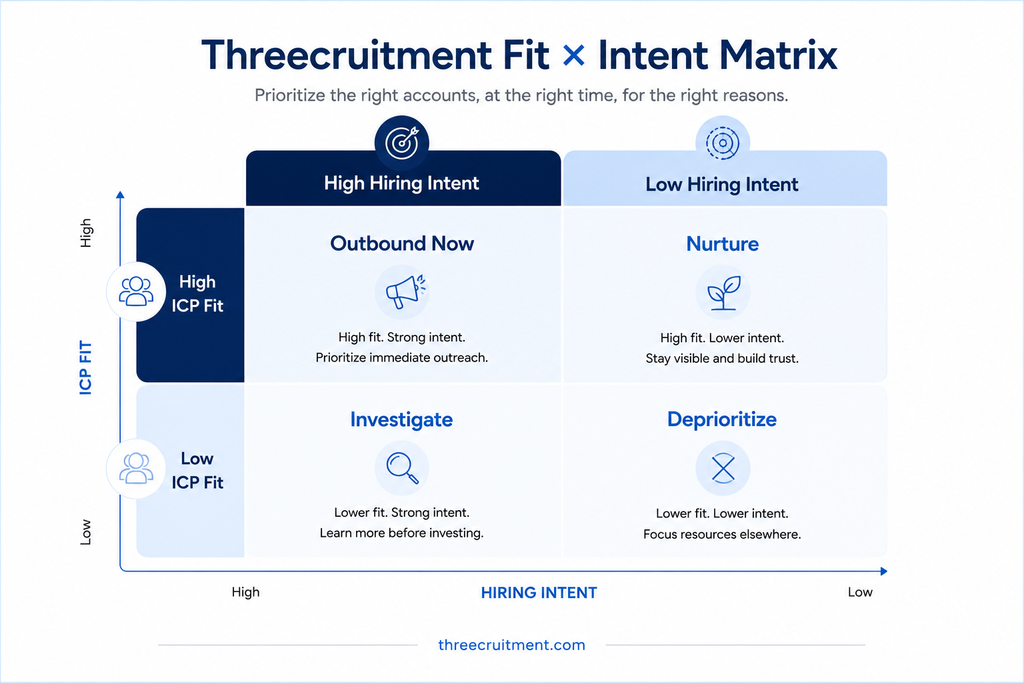
High Fit + High Intent: Outbound Now
These companies match your specialization and show meaningful current signals.
Example:
A fintech company inside your target size and geography is hiring five security engineers, has reposted two specialist positions and recently appointed a security leader.
Research the account and initiate relevant outreach.
High Fit + Low Intent: Nurture
The account is strategically attractive, but there is no strong reason to approach it today.
Example:
A specialist manufacturer regularly hires profiles you recruit, but currently has little relevant hiring activity.
Monitor it rather than forcing a generic pitch.
Low Fit + High Intent: Investigate
There is obvious hiring activity, but the account may fall outside your real delivery capability.
Example:
A rapidly growing healthcare business has 40 vacancies, while your agency specializes exclusively in software engineering.
Large hiring volume does not automatically make it your opportunity.
Low Fit + Low Intent: Deprioritize
There is little strategic fit and little evidence of current need.
Do not spend substantial research time simply because contact data is available.
Create a simple recruitment prospect score
You can operationalize the matrix by scoring factors such as:
- ICP fit;
- relevant hiring volume;
- role difficulty;
- hiring urgency;
- internal recruitment capacity;
- strength of current trigger;
- decision-maker access;
- previous relationship.
The scoring model should reflect your own agency economics.
Do not create mathematical precision where none exists.
Its purpose is simply to make prioritization more consistent.
How to Identify the Right Decision-Maker
Finding the right company does not guarantee you have found the right person.
And the answer is not always “HR.”
Founder or CEO
Often relevant in smaller companies, particularly where:
- there is no dedicated TA function;
- hiring is strategically important;
- senior leadership roles are involved;
- growth plans are founder-led.
CTO or VP Engineering
Relevant when your agency recruits specialist technology roles and the operational hiring pain sits inside engineering.
They may understand the problem more acutely than a generic HR contact.
Hiring Manager
A functional hiring manager may directly experience:
- lack of candidates;
- poor applicant quality;
- slow hiring;
- delivery pressure caused by vacancies.
They may not control supplier approval, but they can be an important stakeholder.
Head of Talent or Talent Acquisition
In larger organizations, TA leaders may:
- own agency relationships;
- manage recruitment capacity;
- coordinate external suppliers;
- understand where internal sourcing is struggling.
An internal TA team should not automatically be treated as an obstacle. External agencies are often used selectively rather than as replacements for internal recruitment.
HR Director
HR leadership may become relevant where recruitment suppliers, budgets, workforce planning or procurement sit within a wider HR structure.
Map more than one person
For important accounts, avoid creating a single-contact dependency.
A recruitment buying decision might involve:
Hiring Manager → Talent Acquisition → HR or Procurement
or:
Founder → Functional Leader → Finance
Map the buying situation rather than assuming one universal title.
How to Build a Recruitment Prospecting List
A useful prospecting list should explain why each company deserves attention.
Use fields like these:
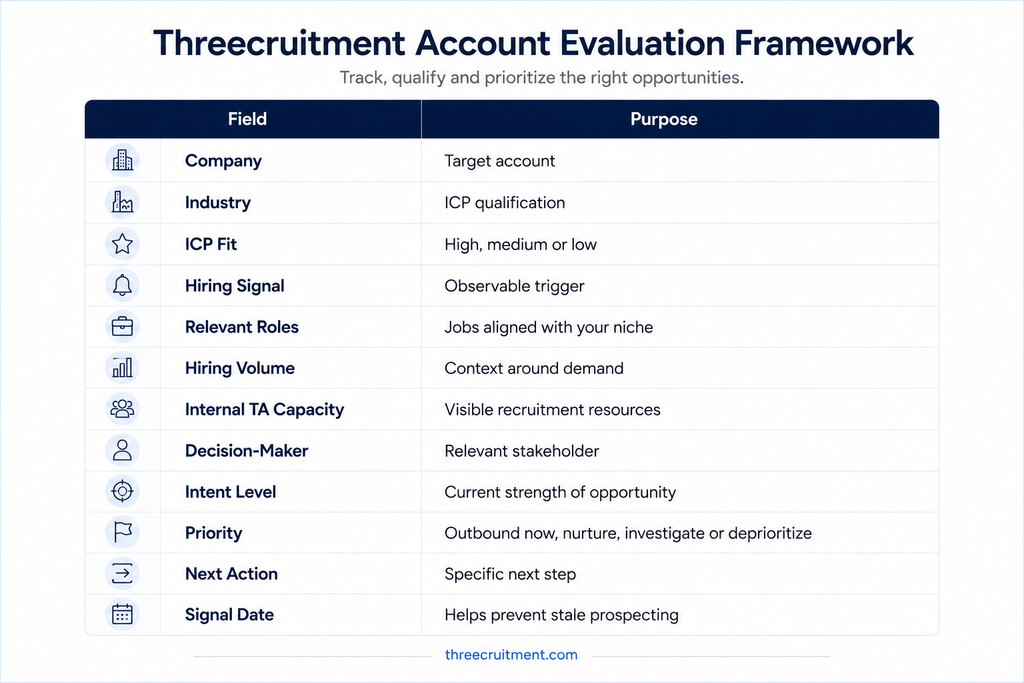
Do not optimize this table for the number of rows.
Optimize it for the number of accounts where someone on your team can answer:
- Why this company?
- Why now?
- What hiring problem might exist?
- Why are we relevant?
- Who should we speak to?
- What should happen next?
A list of 1,000 companies with no answer to those questions is mostly data.
A smaller list of properly qualified accounts can function as a sales pipeline input.
From Prospect Identification to Conversation
Finding the right company solves targeting.
It does not solve outreach.
A simple workflow is:
Signal → qualification → stakeholder → research → relevant outreach → follow-up → conversation
The outreach should connect four things:
- the observed signal;
- the likely hiring problem;
- your agency’s relevance;
- a low-friction reason to respond.
For example, “I saw you’re hiring” is weak because it says almost nothing.
The useful insight might be that the company is building a new engineering team in a market where your agency already recruits the relevant profiles.
That creates context for a conversation.
This article deliberately stops there.
How to write the email, structure follow-up sequences or run a cold call deserves separate treatment.
Finding the right accounts is only the first part of client acquisition
Threecruitment helps recruitment agencies turn prospect intelligence into systematic outreach and qualified client conversations.
Common Mistakes Recruitment Agencies Make When Looking for Clients
Targeting every company with a vacancy
A vacancy confirms hiring activity, not agency demand.
Qualify what sits behind it.
Confusing database size with pipeline
Contacts are inputs.
Pipeline requires credible opportunities and conversations.
Treating funding as automatic intent
Funding becomes useful when business plans around it indicate relevant recruitment activity.
Ignoring ICP fit
An employer can have urgent vacancies and still be a poor account for your agency.
Contacting only generic HR addresses
Identify people connected to the hiring problem and supplier decision instead of assuming every opportunity belongs in a general HR inbox.
Using stale hiring information
A six-month-old trigger may no longer justify today’s outreach.
Record when signals were observed.
Failing to check internal recruitment capacity
Two companies with identical vacancy counts can have completely different need for external support.
Prioritizing activity over opportunity quality
More calls, contacts and emails are not useful if poor account selection sits underneath them.
Ignoring former clients and previous prospects
A company that previously said “not now” can become valuable when circumstances change.
Spending too much research time on low-value accounts
Qualification should improve sales efficiency, not create endless desk research.
Match research depth to potential account value.
A Practical Weekly Recruitment Prospecting Workflow
The exact cadence will depend on your desk and sales model, but a simple weekly rhythm might look like this.
Monday: identify signals
Review:
- new vacancies;
- repeated roles;
- company announcements;
- expansions;
- leadership changes;
- CRM alerts;
- previous prospects.
Add potentially relevant accounts.
Tuesday: qualify accounts
Assess:
Fit + Need + Timing + Access
Remove weak accounts before spending more time on them.
Wednesday: identify stakeholders
Map the likely:
- business owner;
- hiring owner;
- TA stakeholder;
- commercial decision-maker.
For higher-value opportunities, identify more than one person.
Thursday: research and initiate outreach
Build enough account context to explain why your approach is relevant now.
Then initiate your chosen outreach process.
Friday: follow up and review
Update your CRM.
Ask:
- Which signals produced replies?
- Which accounts became conversations?
- Which assumptions were wrong?
- Which trigger types repeatedly produced weak opportunities?
- Which accounts should move into nurture?
This schedule is illustrative.
The principle matters more than the weekdays:
continuous signal discovery → qualification → outreach → feedback
How to Know Whether Your Prospecting Strategy Is Working
Do not judge recruitment prospecting by the size of your contact database.
Track progression through the opportunity chain.
Useful metrics include:
- target accounts identified;
- qualified accounts;
- relevant decision-makers identified;
- conversations generated;
- meetings booked;
- qualified opportunities;
- vacancies received;
- clients won;
- source-to-opportunity conversion.
The number of contacts added is a weak success metric on its own.
Suppose one prospect source adds hundreds of companies but almost none become conversations.
Another produces far fewer accounts, but several progress into genuine recruitment discussions.
The second source may be far more valuable.
Over time, measurement should help you improve not only outreach, but which accounts enter outreach in the first place.
Final Takeaway
The best recruitment prospect is not simply a company with an open job.
It is a company where four things begin to align:
Fit + Need + Timing + Access
Fit tells you whether the company belongs in your market.
Need tells you whether there is a recruitment problem you can solve.
Timing tells you why the problem may matter now.
Access tells you whether you can reach somebody capable of moving the conversation forward.
Hiring signals help you discover potential opportunities.
Qualification tells you which signals deserve action.
Prioritization prevents your recruitment business development team from treating every company as equally valuable.
That is the difference between building a large prospect database and building a list of companies actually worth pursuing.
Turn Better Targeting Into Qualified Opportunities
Threecruitment helps recruitment agencies identify the right accounts, prioritize hiring signals and build systematic outreach that creates qualified client conversations.
See How Threecruitment Works
FAQs about how to find clients for a recruitment agency
How do recruitment agencies find clients?
Recruitment agencies find clients through referrals, professional networks, previous relationships, hiring signals, job advertisements, company research, LinkedIn and direct prospecting. A stronger process combines these sources with an ideal client profile so the agency prioritizes companies where there is both commercial fit and evidence of a current or emerging recruitment need.
How do I find companies that need recruiters?
Start with companies matching your recruitment niche, then look for evidence of hiring pressure. Useful signals include multiple specialist vacancies, repeated job postings, rapid increases in hiring, expansion, limited internal recruitment capacity and new leadership. No individual signal proves that a company needs an agency, so qualify the wider context before approaching it.
Are companies that are hiring good recruitment leads?
Some are. A job posting confirms that a company is hiring, but it does not prove that external recruitment support is required. Evaluate the type of role, hiring volume, urgency, internal recruitment capacity, company fit and other business signals before treating the employer as a qualified recruitment prospect.
Where can recruitment agencies find leads?
Recruitment agencies can find potential leads through LinkedIn, company careers pages, job boards, company newsrooms, business publications, funding databases, Google search, existing CRM records, former clients, previous prospects, professional networks and market conversations. The source identifies potential accounts. Qualification determines whether they are worth pursuing.
How can I tell if a company uses recruitment agencies?
Look for previous relationships in your CRM, known supplier relationships, referrals, previous communications, historical agency involvement or information shared by relevant market contacts. Public evidence may be incomplete, so previous agency use should be treated as useful context rather than proof that a company is currently buying recruitment services.
What are hiring signals in recruitment business development?
Hiring signals are observable events or patterns suggesting that recruitment demand may exist or emerge. Examples include new vacancies, repeated job advertisements, hiring-volume increases, expansion, relevant leadership changes and funding linked to workforce growth. Signals improve timing, but they still need to be evaluated against ICP fit and recruitment context.
Who should a recruitment agency contact at a prospective client?
The right contact depends on company size, role type and how recruitment decisions are made. Relevant stakeholders may include the Founder, CEO, CTO, functional hiring manager, Head of Talent, Talent Acquisition Lead or HR Director. For valuable accounts, map several stakeholders rather than relying on one generic HR contact.
How many companies should a recruitment agency prospect each week?
There is no useful universal number. The appropriate volume depends on account value, specialization, required personalization, sales capacity and outreach model. A highly specialized executive search firm may research far fewer accounts than a high-volume staffing business. Measure qualified opportunities and conversations rather than optimizing prospecting solely for the number of companies contacted.

Author
Edmond Široka
Founder @ Threecruitment
Edmond has spent more than a decade working across recruitment, HR, sales and business development. His experience includes agency recruitment, in-house talent acquisition, HR leadership and running a recruitment business. Today, he focuses on building practical client acquisition systems for recruitment agencies.