Lead Generation for Recruitment Agencies: A Practical Guide for 2026
Table of contents
- Build Your Ideal Client Profile Before Prospecting
- Use Hiring Signals to Find Companies at the Right Time
- Cold Email Lead Generation for Recruitment Agencies
- LinkedIn Lead Generation for Recruitment Agencies
- Cold calling still works, but only if the call has a reason
- SEO and Inbound Lead Generation
- Optimize for AI Search and Generative Engines
- Content Marketing That Actually Generates Recruitment Leads
- Referral and Network Lead Generation
- Candidate-Led Business Development
- Trigger-Based and Account-Based Prospecting
- Use AI as a Research and Productivity Layer
- Paid Acquisition and Retargeting
- Build a Multichannel Recruitment Lead Generation System
- Measure the Right Recruitment Lead Generation KPIs
- Recruitment Agency Lead Generation Mistakes to Avoid
- A Practical 90-Day Lead Generation Plan for Recruitment Agencies
- FAQ
- Conclusion
Lead generation for recruitment agencies in 2026 is the systematic process of identifying employers likely to need external recruitment support, reaching the right decision-makers at the right moment, and converting that interest into qualified sales conversations. The strongest approach combines hiring-intent signals, targeted outbound prospecting, LinkedIn, referrals, SEO, useful content, AI-assisted research, and disciplined follow-up.
The important word is systematic.
Recruitment agencies have historically relied heavily on recruiter networks, cold calls, speculative CVs, job-board monitoring, referrals and high-volume email campaigns. Some of those tactics still work. The problem is that using them in isolation or executing them as they were five years ago is increasingly ineffective.
B2B buyers can research suppliers independently. AI makes basic prospect research dramatically easier for both sellers and buyers. Decision-makers receive more automated outreach. Email providers have strengthened sender requirements. Search behaviour is expanding beyond conventional Google results into AI-generated answers. Meanwhile, recruitment agencies can use increasingly sophisticated data to recognize when a company is entering a hiring cycle.
That means the competitive advantage in 2026 is not simply having a larger prospect database.
It is identifying the right company, the right person, the right hiring problem and the right moment, then delivering a relevant message through the right channel.
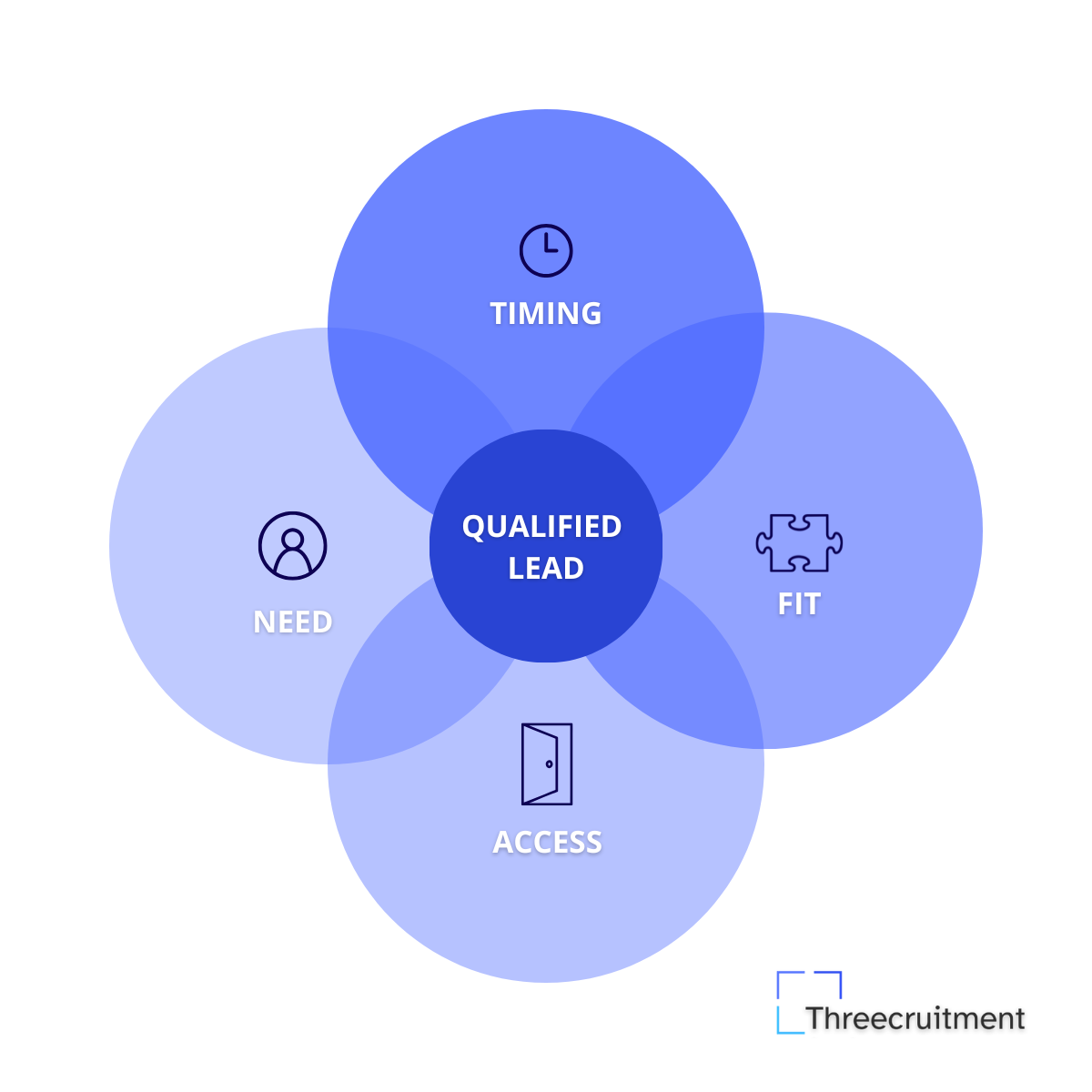
At Threecruitment, we look at recruitment lead generation as a system rather than a single channel. Databases, cold email, LinkedIn or calls are simply components. The real objective is to identify companies where fit, need, timing and access overlap.
This guide explains how to build that system.
What Is Lead Generation for Recruitment Agencies?
Lead generation for a recruitment agency is the process of finding and attracting organizations that could become recruitment clients.
This is different from candidate generation.
A recruitment business operates a two-sided model:
- Candidate acquisition builds a pool of professionals who may fill vacancies.
- Client lead generation identifies employers willing to pay the agency to help fill vacancies.
A lead might therefore be:
- a Head of Talent at a scaling technology company;
- an HR director whose organization has opened several specialist vacancies;
- a founder making the company’s first senior hires;
- a manufacturing business opening a new facility;
- a previous client that has started hiring again;
- a company that has repeatedly advertised a difficult-to-fill position;
- or a hiring manager introduced by a candidate or existing customer.
Not all of these leads deserve equal attention.
A useful recruitment lead normally combines four elements:
Fit + need + timing + access.
A company that fits your niche but has no hiring requirement is an account, not necessarily an immediate opportunity.
A company with 30 vacancies but outside your specialism may also be a poor opportunity.
A company with the right vacancies, inside your specialist market, with an identifiable hiring manager and evidence of recruitment difficulty is much more valuable.
That distinction should drive your entire lead-generation strategy.
Why Recruitment Lead Generation Has Changed in 2026
Three developments matter particularly in 2026: buyers have more information, sellers have more automation, and relevance has therefore become more valuable.
Recent B2B research illustrates the shift. Gartner reported in 2025 that 61% of surveyed B2B buyers preferred an overall rep-free buying experience, while 73% actively avoided suppliers sending irrelevant outreach. Its 2026 research found that buyers used an average of seven information sources in a recent purchase and that 45% had used generative AI, primarily to gather vendor and product information. At the same time, 69% preferred validating AI-generated insights with sales representatives.
The lesson for recruitment agencies is important: buyers increasingly want to research independently, but human expertise still matters when the decision becomes contextual.
Your agency therefore needs two engines operating together.
The first is a demand-capture engine. It makes your expertise discoverable through search, AI platforms, useful content, case studies, niche landing pages, referral networks and a credible website.
The second is a demand-generation engine. It proactively identifies employers showing relevant signals and starts conversations through email, phone, LinkedIn, events, introductions and other channels.
Agencies relying only on inbound may wait too long for opportunities.
Agencies relying only on aggressive outbound risk becoming part of the irrelevant sales noise buyers increasingly avoid.
The strongest model combines both.
1. Build Your Ideal Client Profile Before Prospecting
One of the most expensive mistakes in recruitment business development is beginning with a contact database rather than an ideal client profile.
If you recruit cybersecurity professionals, for example, “companies hiring cybersecurity staff” is still an extremely broad market.
Your ideal client profile, or ICP, should answer several practical questions.
Industry
Which industries consistently require your candidates?
For a cybersecurity recruitment agency, that might include financial services, SaaS companies, consultancies, managed security providers and regulated enterprises.
Company size
A 40-person startup and a 20,000-person multinational can require completely different sales approaches.
Company size affects:
- recruitment volume;
- internal talent-acquisition capacity;
- procurement complexity;
- agency usage;
- hiring-manager accessibility;
- budgets;
- decision speed.
Geography
Define where you can genuinely deliver.
Avoid claiming national or international coverage simply because your database contains candidates in those markets.
Hiring profile
Identify the positions where you have an actual advantage.
For example:
- software engineering;
- finance leadership;
- registered healthcare professionals;
- warehouse and logistics staff;
- skilled manufacturing;
- cybersecurity;
- renewable energy;
- executive leadership.
Hiring frequency
Recurring hiring is often more valuable than isolated vacancies.
A company hiring 20 similar professionals each year can be a stronger long-term client than a larger organization making one relevant hire.
Recruitment problem
This is particularly important.
Ask what causes the employer to consider an agency.
Potential problems include:
- insufficient applications;
- poor candidate quality;
- niche skills shortages;
- excessive time-to-hire;
- confidential hiring;
- expansion into an unfamiliar market;
- internal recruitment capacity constraints;
- high candidate drop-off;
- urgent project staffing;
- hard-to-fill locations.
Your proposition should map directly to one or more of these problems.
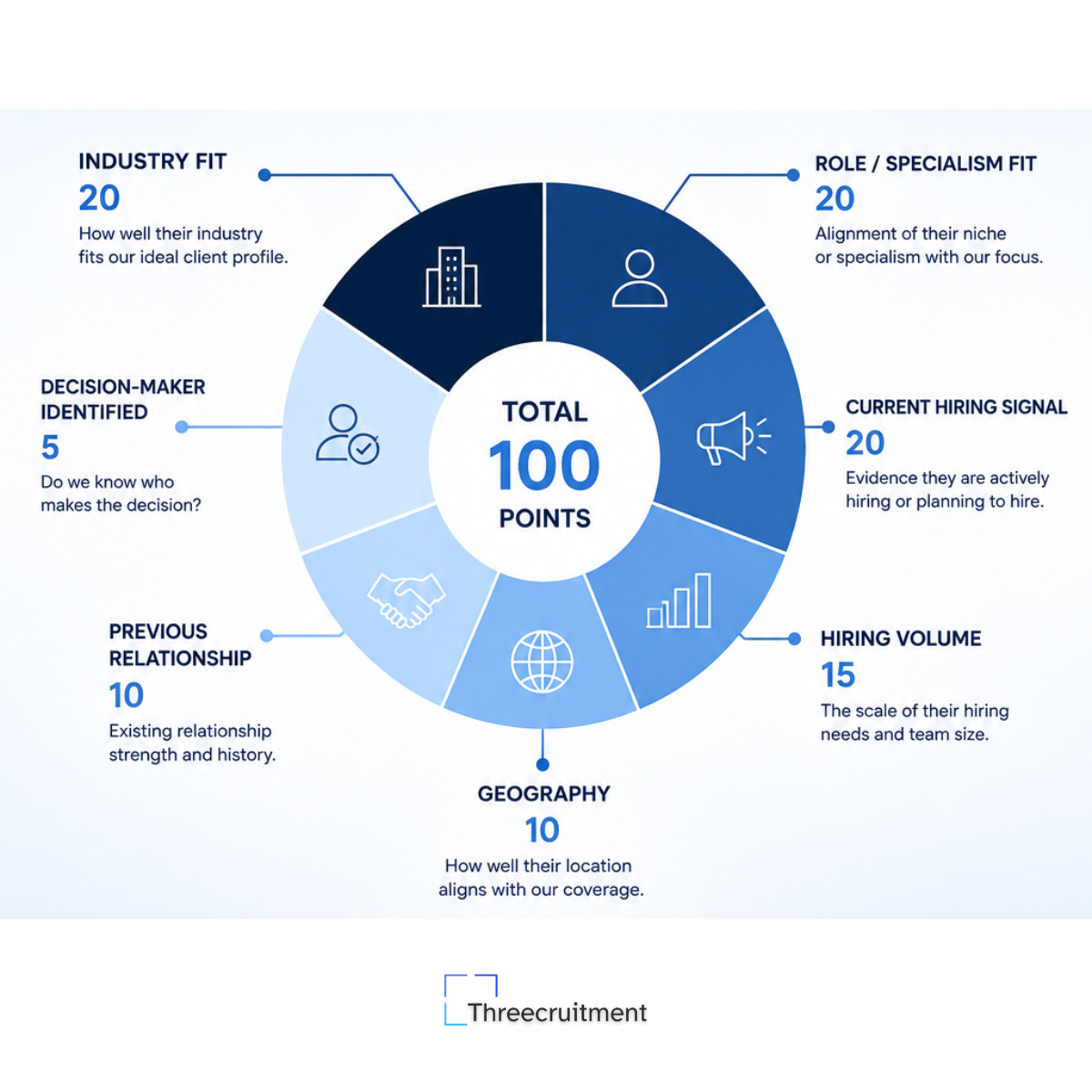
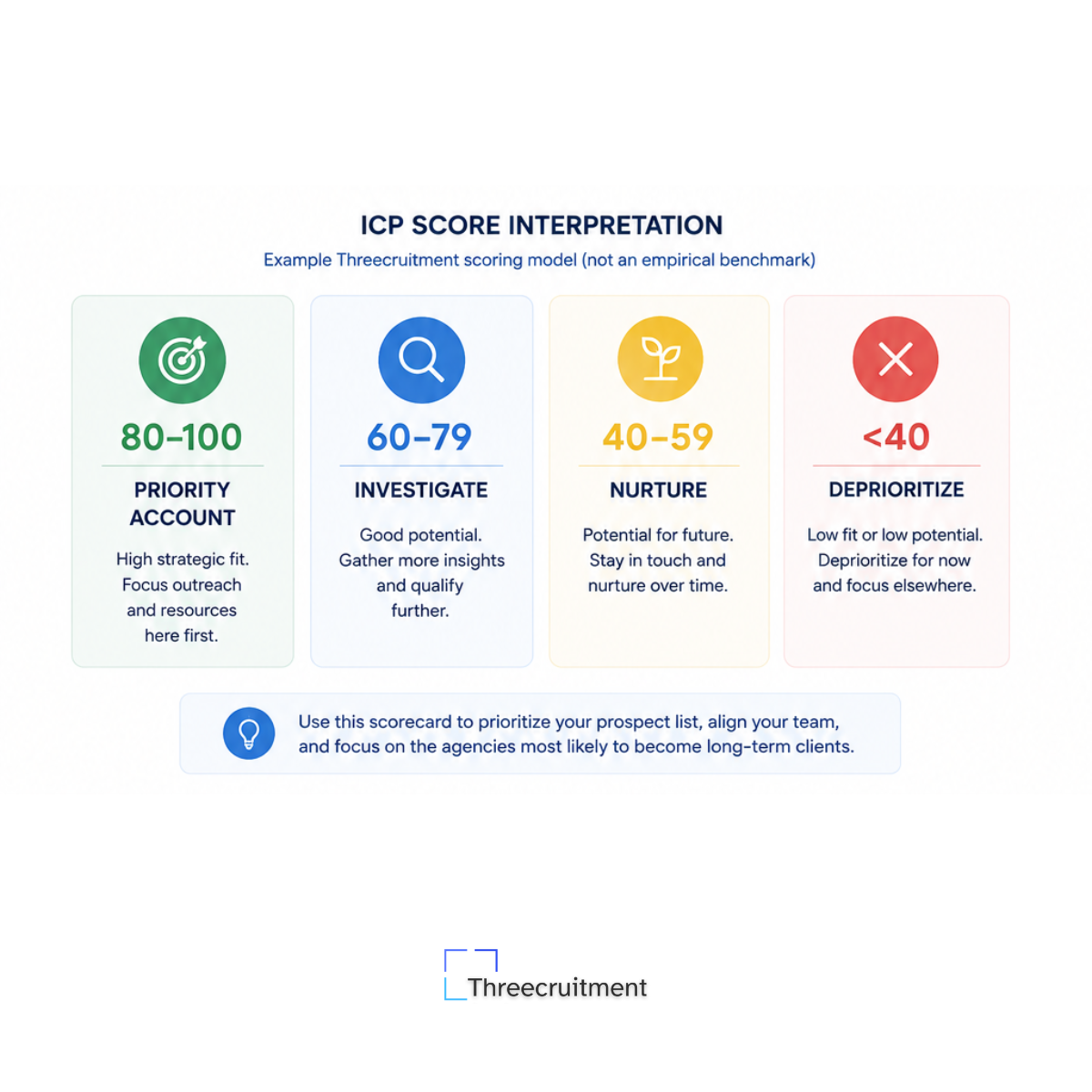
Create an ICP Score
Instead of treating every company equally, create a simple 100-point model.
For example:
| Factor | Maximum Score |
|---|---|
| Industry fit | 20 |
| Role/specialism fit | 20 |
| Geography | 10 |
| Hiring volume | 15 |
| Current hiring signal | 20 |
| Decision-maker identified | 5 |
| Previous relationship | 10 |
| Total | 100 |
The exact weighting should reflect your business.
The principle matters more than the formula: recruiters should spend disproportionate business-development time on accounts most likely to buy.
2. Use Hiring Signals to Find Companies at the Right Time
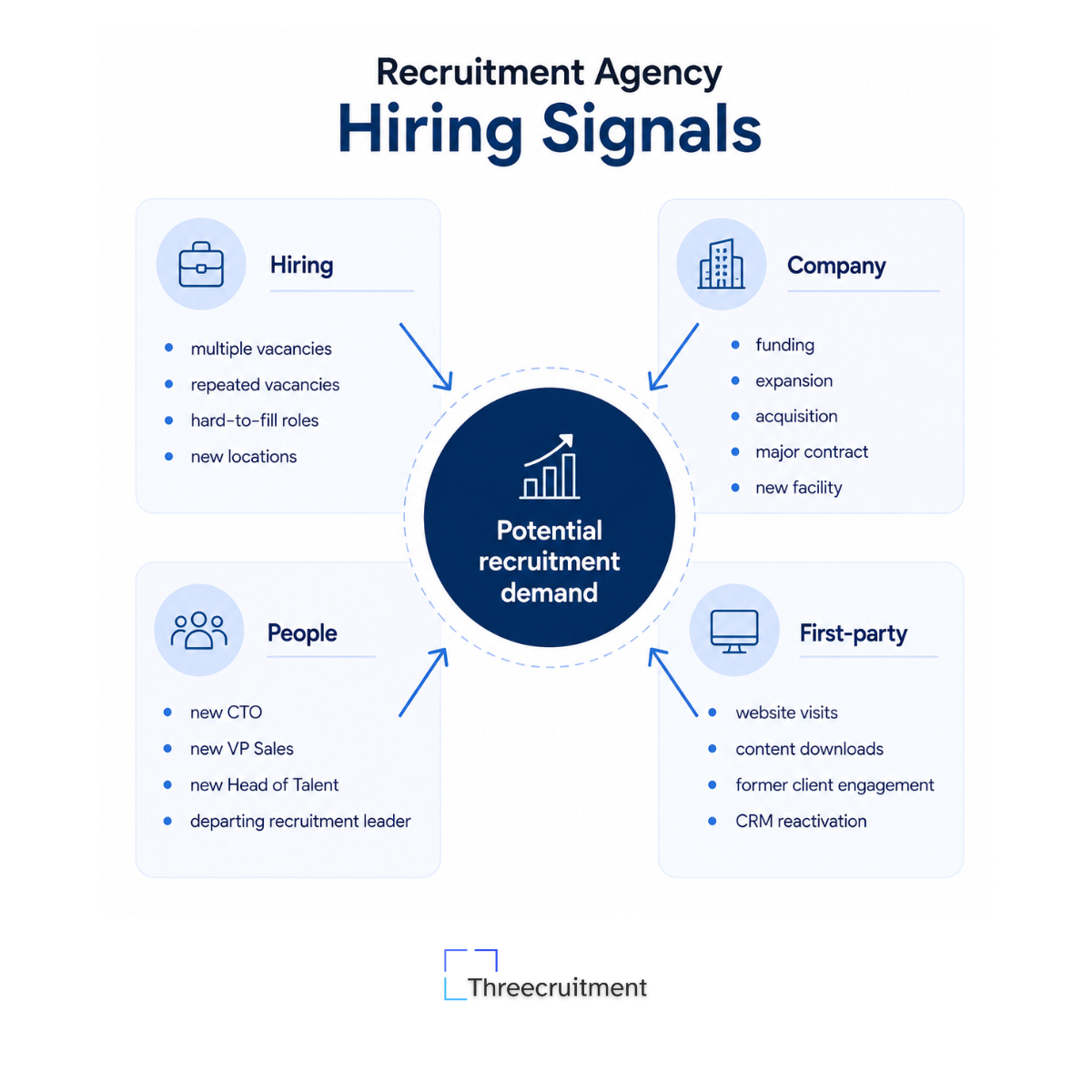
Static databases tell you who exists.
Signals tell you who may need you now.
This is one of the biggest differences between basic list building and effective recruitment lead generation in 2026.
Monitor New Job Vacancies
A new vacancy is an obvious hiring-intent signal, but do not automatically contact every company publishing a job.
Look for patterns.
A company advertising one ordinary vacancy may not need an agency.
A company advertising eight technical positions within three weeks may have entered a meaningful growth phase.
Similarly, a specialist role that remains open for 60 days may signal a sourcing problem.
Track:
- new vacancies;
- repeated vacancies;
- vacancies reopened after closing;
- multiple jobs within your niche;
- hiring across a new location;
- senior appointments;
- jobs marked urgent;
- roles remaining open unusually long.
Track Funding and Investment
Funding can precede hiring, particularly in venture-backed markets.
But “Congratulations on your funding” is now one of the most predictable prospecting messages a founder can receive.
Go deeper.
Instead of treating funding itself as the reason to contact a prospect, investigate what the company plans to do with it.
If the business announces plans to:
- enter three new markets;
- expand its engineering organization;
- establish a European office;
- launch a new division;
- or increase production capacity,
you have a specific workforce hypothesis.
That creates a better conversation.
Monitor Expansion Signals
Useful events include:
- new offices;
- new factories or warehouses;
- geographic expansion;
- major contracts;
- acquisitions;
- product launches;
- new business units;
- leadership appointments.
The key is connecting the event to a probable recruitment requirement.
Watch People Changes
A newly appointed Chief Technology Officer may restructure an engineering function.
A new VP of Sales may build a sales team.
A new Head of Talent may review agency suppliers.
A departing recruitment leader may temporarily reduce internal hiring capacity.
These are not guaranteed opportunities. They are signals worth investigating.
Track First-Party Intent
Your own website and CRM can produce powerful signals.
Examples include:
- a previous prospect revisiting a service page;
- a former client downloading a salary guide;
- repeated visits to your employer page;
- an old client engaging with new content;
- webinar registrations;
- newsletter engagement;
- replies to old campaigns.
Where tracking is used, implement it in accordance with applicable privacy and consent requirements.
First-party signals can be more valuable than generic third-party data because the prospect is already interacting with your agency.
3. Cold Email Lead Generation for Recruitment Agencies
Cold email still has a place in recruitment business development, but the economics have changed.
AI has made it cheap to produce thousands of superficially personalized messages.
That makes genuine relevance more important, not less.
Start With Segmentation
Never send the same recruitment pitch to:
- a startup founder;
- an HR director;
- a talent-acquisition manager;
- a CTO;
- and a procurement manager.
They have different problems.
Segment campaigns by variables such as:
- industry;
- role;
- hiring signal;
- company size;
- geography;
- prospect seniority;
- likely recruitment challenge.
A campaign targeting 80 Heads of Engineering at SaaS companies currently advertising multiple backend engineering positions can support a much more relevant message than a generic campaign to 10,000 “HR contacts.”
Build the Message Around a Trigger
A strong outbound email should answer four questions quickly:
- Why this company?
- Why now?
- Why your agency?
- What should the reader do next?
For example, your message might reference the fact that the company is building a new data function and then explain the relevant talent pool your agency specializes in.
Avoid empty personalization.
“Congratulations on your recent growth” is not meaningful if it leads immediately into the same generic agency pitch sent to everybody else.
Use Proof Carefully
Relevant evidence can strengthen outreach.
Examples include:
- experience recruiting the same job family;
- knowledge of local salary expectations;
- access to a specific candidate community;
- a relevant client outcome;
- market data on candidate availability.
Never invent numbers, clients or case studies.
If you have genuine evidence, make it specific enough to matter.
Make the CTA Easy
Cold prospects do not necessarily want a 30-minute discovery meeting.
Test lower-friction calls to action such as:
- “Would it be useful if I sent our current salary range for this role?”
- “Are you open to external support on these hires?”
- “Would a shortlist of currently available profiles be useful?”
- “Is this something you manage, or does another person own agency recruitment?”
The objective of the first message is often to start a relevant conversation, not close a contract.
Protect Email Deliverability
Deliverability is no longer an afterthought.
Google requires senders to meet authentication and spam-control requirements for mail sent to personal Gmail accounts. Higher-volume senders have additional requirements, including SPF, DKIM, DMARC and one-click unsubscribe requirements for applicable marketing/subscribed messages. Google also recommends gradually increasing sending volume and monitoring reputation and spam rates.
For recruitment agencies, practical email hygiene should include:
- properly configured SPF;
- DKIM;
- DMARC;
- valid DNS;
- sensible sending volume;
- accurate sender identity;
- bounce monitoring;
- suppression lists;
- straightforward opt-out processes;
- removing persistently invalid contacts.
Do not view additional domains as permission to send indiscriminately. Domain infrastructure cannot compensate for irrelevant outreach.
Follow the Law
Rules differ by jurisdiction and by communication type.
For example, the US CAN-SPAM Act applies to commercial email and does not provide a general B2B exemption. It imposes requirements concerning accurate sender information, non-deceptive subject lines, postal-address disclosure and opt-out handling.
If you prospect internationally, determine which privacy, electronic-communications and direct-marketing laws apply to your location, the prospect’s location and the data you process.
Compliance should be designed into the process rather than added after a campaign has been built.
4. LinkedIn Lead Generation for Recruitment Agencies
LinkedIn remains especially relevant to recruitment because recruiters, hiring managers, HR professionals and candidates already use the platform professionally.
The mistake is reducing LinkedIn lead generation to connection requests followed by immediate pitches.
Optimize Individual Profiles
People frequently inspect the recruiter’s profile before replying.
Your profile should make four things immediately clear:
- who you help;
- what roles or market you specialize in;
- what problem you solve;
- why someone should trust your expertise.
A recruiter headline that simply says “Senior Recruitment Consultant at ABC Recruitment” says very little to a potential buyer.
A more useful positioning statement identifies the market.
For example:
Helping UK SaaS companies hire senior data and AI professionals | Data & AI Recruitment
Your About section can then explain:
- target clients;
- core roles;
- geographic coverage;
- market expertise;
- evidence or credentials;
- contact route.
Build Visibility Before You Need the Lead
Publishing consistently gives prospects opportunities to encounter your expertise before receiving outreach.
Useful recruiter content includes:
- salary movements;
- candidate availability;
- role-specific hiring advice;
- interview trends;
- skill shortages;
- market observations;
- anonymized candidate insights;
- hiring mistakes;
- compensation comparisons;
- workforce trends.
The objective is not posting motivational quotes every morning.
It is becoming recognizable for a particular area of recruitment expertise.
Engage With Target Accounts
Follow your highest-priority accounts and relevant decision-makers.
Pay attention to:
- hiring announcements;
- leadership changes;
- business expansion;
- posts discussing recruitment difficulties;
- team achievements;
- new initiatives.
When appropriate, contribute useful comments without forcing a pitch into every interaction.
Use LinkedIn for Research and Human Interaction
LinkedIn explicitly restricts unauthorized third-party software that scrapes its services or automates activity such as messaging and engagement.
That makes a sustainable approach straightforward: use approved functionality and prioritize genuine research and interactions rather than risky mass automation.
Automation can assist your internal workflow elsewhere, but authenticity on the platform is strategically useful anyway.
5. Cold calling still works, but only if the call has a reason
Cold calling is sometimes treated as obsolete because buyers have shifted toward digital research.
That conclusion is too simplistic.
A generic call asking whether a company “uses recruitment agencies” is weak.
A timely call based on a relevant business signal is different.
Imagine these openings:
Weak:
“We’re a specialist recruitment agency and I wondered whether you use external recruiters.”
Stronger:
“I noticed you’re building the controls engineering team in Birmingham and currently have six roles open. We recruit specifically in that market, so I wanted to understand whether those positions are fully covered internally.”
The second call has context.
Prepare Before Calling
Before contacting a high-value prospect, know:
- what the company does;
- what it is hiring;
- why the hiring may be difficult;
- who likely owns the requirement;
- what relevant evidence you can provide;
- what question you want answered.
Do not turn research into procrastination. A few focused minutes can be enough.
Use Calls Within a Sequence
Cold calling works particularly well as part of a multichannel sequence.
A prospect may:
- see your LinkedIn post;
- receive a relevant email;
- visit your website;
- receive a phone call;
- recognize your agency name.
Each touch increases context for the next one.
6. SEO and Inbound Lead Generation
Outbound captures attention.
SEO captures existing demand.
Recruitment agencies should build pages around the questions employers search when they already have a hiring problem.
Build Commercial Service Pages
Do not depend on one generic “Recruitment Services” page.
Create focused pages where there is genuine business relevance.
Examples include:
- cybersecurity recruitment agency;
- finance recruitment agency;
- executive search for SaaS companies;
- engineering recruitment in Manchester;
- renewable energy recruitment;
- contract software developer recruitment.
Each page should provide substantive information rather than being a location or keyword swap.
Include:
- roles recruited;
- industries served;
- process;
- geographic coverage;
- relevant expertise;
- FAQs;
- genuine proof where available;
- a clear employer CTA.
Build Problem-Led Content
Not every high-value search contains “recruitment agency.”
An employer may search:
- how to hire a cybersecurity engineer;
- average data scientist salary London;
- why software developers reject job offers;
- how long should executive recruitment take;
- permanent vs contract developers;
- how to recruit engineers in Germany.
These searches happen earlier in the buying journey.
A specialist agency that answers them well can enter the consideration set before the employer searches for an agency.
Build Topic Clusters
If your niche is renewable energy recruitment, your website could contain clusters around:
- solar hiring;
- wind-energy recruitment;
- battery-storage talent;
- salary benchmarks;
- engineering skills shortages;
- executive hiring;
- project staffing.
Link those resources naturally to your commercial recruitment pages.
Avoid Scaled Low-Value AI Content
AI can accelerate research, briefs, editing and content repurposing, but publishing hundreds of thin pages simply to capture keyword variations is risky and rarely useful to prospects.
Google’s spam policies specifically address scaled content created primarily to manipulate rankings rather than help users.
The better approach is to use AI to improve the economics of producing original, expert-reviewed, genuinely useful content.
7. Optimize for AI Search and Generative Engines
By 2026, recruitment agencies should think beyond conventional search rankings.
Potential clients increasingly ask AI systems questions such as:
- “Who are specialist fintech recruitment agencies in London?”
- “How much does an engineering recruitment agency charge?”
- “What is the best way to recruit cybersecurity analysts?”
- “Which recruitment firms specialize in renewable energy?”
An agency cannot force an AI platform to mention it.
It can, however, make its website and wider entity presence easier to understand.
Make Your Specialism Explicit
Your site should clearly state:
- company name;
- services;
- specialisms;
- industries;
- locations;
- candidate types;
- recruitment models;
- relevant credentials.
Do not make search engines or AI systems infer your entire proposition from vague copy such as “connecting exceptional people with exceptional organizations.”
Publish Citation-Friendly Information
Useful content contains clear factual passages.
Instead of:
“The technology talent landscape is constantly evolving at an unprecedented pace.”
Write:
“Senior machine-learning recruitment typically requires a different sourcing strategy from general software engineering because the candidate pool is narrower and role requirements vary significantly by model, infrastructure and product environment.”
Specific language is easier for humans and machines to understand.
Strengthen Your Entity Across the Web
Consistent business information across your website and credible third-party profiles can help establish who your agency is.
Focus on legitimate sources, such as:
- professional associations;
- business directories where relevant;
- conference profiles;
- partner websites;
- earned media;
- podcasts;
- original research citations.
Do not create fake citations, fabricated reviews or artificial authority signals.
8. Content Marketing That Actually Generates Recruitment Leads
Recruitment agencies often publish content without connecting it to a commercial objective.
Every piece does not need to sell directly, but you should understand what role it plays.
A useful content funnel might look like this.
Awareness
Content:
- hiring trends;
- industry analysis;
- skills forecasts;
- salary movements.
Objective:
Get discovered.
Consideration
Content:
- salary guides;
- hiring playbooks;
- recruitment process comparisons;
- role-specific hiring guides;
- webinars;
- market reports.
Objective:
Demonstrate expertise and capture interest.
Decision
Content:
- case studies;
- methodology pages;
- testimonials;
- service comparisons;
- FAQs;
- fee explanations;
- consultation pages.
Objective:
Reduce uncertainty and generate enquiries.
Create Proprietary Data Assets
Recruitment businesses sit on valuable market information.
Subject to privacy and confidentiality requirements, aggregated data can support content such as:
- salary benchmarks;
- average notice periods;
- candidate priorities;
- skill availability;
- interview-stage trends;
- offer acceptance patterns.
Original data gives other sites a reason to reference your agency and gives salespeople something genuinely useful to share.
9. Referral and Network Lead Generation
Referrals remain powerful because recruitment is trust-intensive.
The mistake is waiting for referrals to happen accidentally.
Build a process.
Ask Satisfied Clients
The best moment may be after:
- a successful placement;
- positive candidate feedback;
- completion of a difficult search;
- a successful project;
- a strong review meeting.
Make the request specific.
Instead of:
“Do you know anyone who needs recruitment?”
Try:
“We’re looking to work with another two engineering businesses hiring controls specialists this quarter. Is there anyone in your network dealing with that challenge who you’d be comfortable introducing us to?”
Ask Candidates
Candidates change companies.
Today’s candidate can become tomorrow’s hiring manager.
Maintain useful relationships after placement rather than treating candidates as completed transactions.
A placed Head of Sales, CTO, Finance Director or HR leader may later become one of your strongest client relationships.
Build Partner Networks
Potential referral partners include:
- HR consultants;
- payroll providers;
- employment lawyers;
- accountants;
- venture-capital firms;
- private-equity operating teams;
- training providers;
- relocation specialists;
- industry communities.
The strongest partnerships involve complementary services and genuine mutual value, not referral spam.
10. Candidate-Led Business Development
This strategy is unusually well suited to recruitment agencies because the candidate market can reveal client demand.
Suppose your agency represents an excellent candidate with a scarce skill set.
Rather than sending the CV indiscriminately to hundreds of employers, identify a carefully selected group of companies where the person’s experience creates legitimate relevance.
This can open conversations even where no vacancy has been advertised.
Build a Target Company List
Ask:
- Which competitors employ similar professionals?
- Which companies use the same technology?
- Which organizations are expanding the relevant function?
- Which businesses recently lost someone in a comparable role?
- Which firms have historically advertised this position?
Then approach appropriate decision-makers while protecting candidate confidentiality and following applicable privacy requirements.
Sell the Market Insight, Not Just the CV
A good candidate-led conversation can reveal broader intelligence.
For example:
“We’re representing a senior controls engineer with extensive Siemens TIA Portal experience. I noticed your team has been expanding in the same area. Even if this profile isn’t relevant, are controls hires part of your workforce plan this year?”
The candidate creates the opening.
The hiring discussion creates the opportunity.
11. Trigger-Based and Account-Based Prospecting
A recruitment agency with a defined niche should consider borrowing principles from account-based marketing.
Rather than treating every contact as an independent lead, build a target-account universe.
Tier Your Accounts
Tier 1: Highest-value strategic accounts.
Use deep research, multiple contacts, personalized outreach and senior involvement.
Tier 2: Strong-fit companies with current signals.
Use semi-personalized campaigns based on shared characteristics and triggers.
Tier 3: Wider ICP accounts.
Use scalable nurture, content and monitoring until a stronger intent signal appears.
This prevents recruiters from spending identical effort on a 15-person company and a strategic account capable of producing dozens of placements.
Map the Buying Committee
Recruitment purchasing can involve:
- hiring manager;
- internal recruiter;
- Head of Talent;
- HR director;
- department leader;
- finance;
- procurement;
- founder or CEO.
Do not assume the first person contacted owns the entire decision.
For strategic accounts, map several relevant stakeholders.
Combine Fit and Intent
A practical prioritization matrix looks like this:
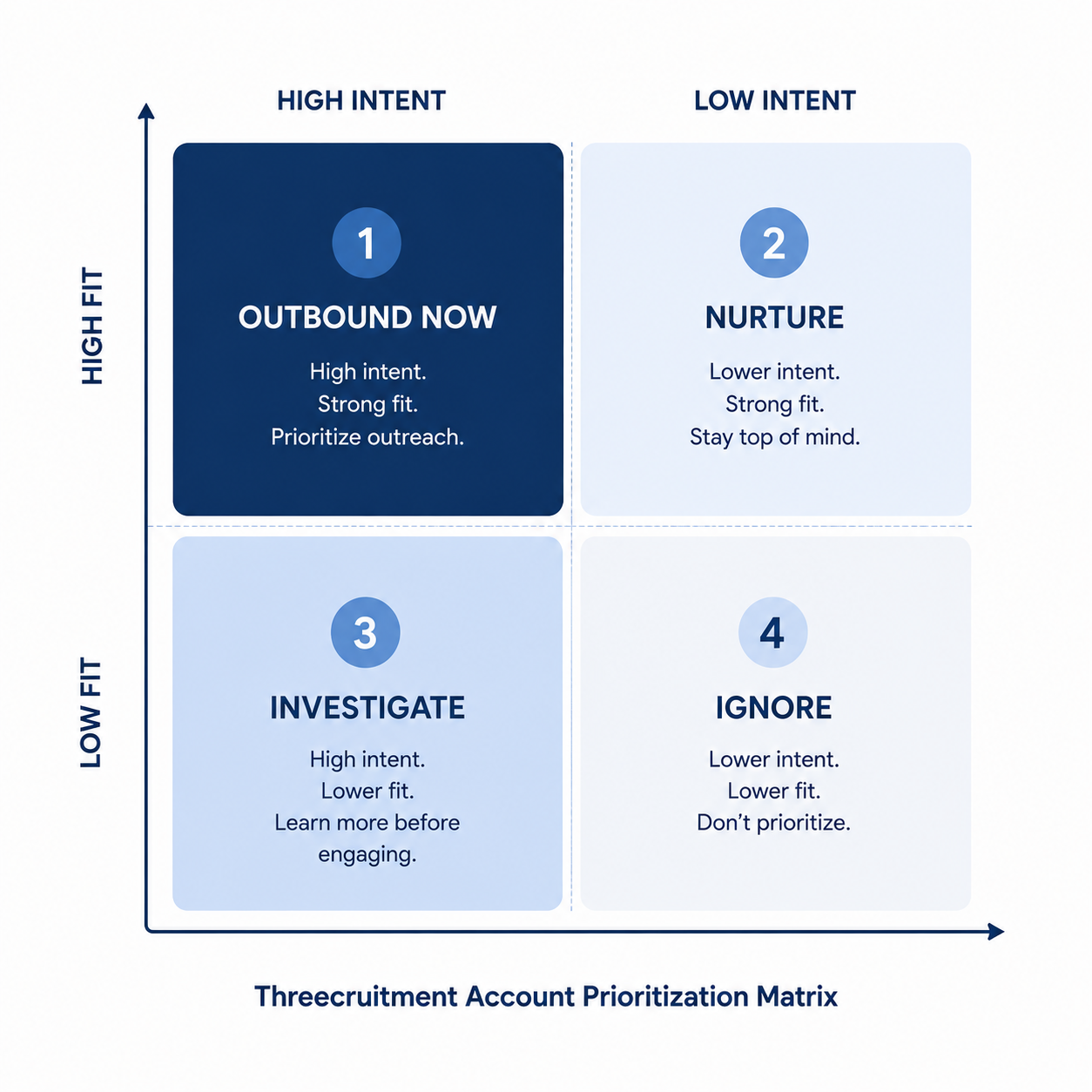
This simple model can prevent substantial wasted prospecting time.
12. Use AI as a Research and Productivity Layer
AI is now a normal part of modern sales workflows. Salesforce’s 2026 State of Sales research reported AI and AI agents as the number-one growth tactic among surveyed sales teams, while HubSpot’s 2026 prospecting coverage reports widespread AI usage among sales professionals.
For recruitment agencies, the opportunity is not “let AI send more messages.”
It is using AI to improve human productivity and relevance.
Practical AI Uses
AI can help recruiters:
- summarize company announcements;
- categorize accounts;
- research industries;
- identify potential hiring implications from business news;
- summarize job descriptions;
- compare multiple vacancies;
- draft first-pass account briefs;
- turn call notes into CRM summaries;
- generate follow-up drafts;
- identify patterns in lost deals;
- repurpose webinars into content;
- analyze anonymized campaign results.
Keep Humans in the Loop
AI can misunderstand context or generate incorrect information.
Important claims should therefore be checked before being sent to prospects or published.
A bad automated message delivered efficiently is still a bad message.
The goal is:
AI for research + human judgment + relevant execution.
Threecruitment principle: AI should improve the quality of recruitment prospecting before it increases the quantity.
Want this system built for your agency?
13. Paid Acquisition and Retargeting
Paid media can work for recruitment agencies, but it needs careful economics.
Recruitment keywords can be competitive, and a click is not a client.
Google Search Ads
Search advertising can capture high-intent queries such as:
- specialist recruitment agency;
- executive search firm;
- engineering recruiters;
- hire software developers;
- finance recruitment agency.
Send traffic to the most relevant landing page, not automatically to your homepage.
The landing page should match the search intent and explain:
- specialization;
- target roles;
- process;
- evidence;
- geographic coverage;
- CTA.
LinkedIn Advertising
LinkedIn can support narrow B2B targeting, particularly for:
- salary reports;
- webinars;
- employer guides;
- executive events;
- account-based campaigns.
Direct “book a recruitment agency” ads to cold audiences may be harder to convert than genuinely useful employer resources.
Retargeting
Someone who reads your salary guide or service page may not enquire immediately.
Retargeting can keep the agency visible while that person continues researching.
Use frequency controls and privacy-compliant tracking.
14. Build a Multichannel Recruitment Lead Generation System
The strongest strategy is not choosing between email, LinkedIn, SEO and phone.
It is assigning each channel a job.
A simplified prospect journey might be:
Signal detected → account qualified → stakeholder identified → research → email → LinkedIn interaction → call → useful resource → follow-up → meeting → opportunity.
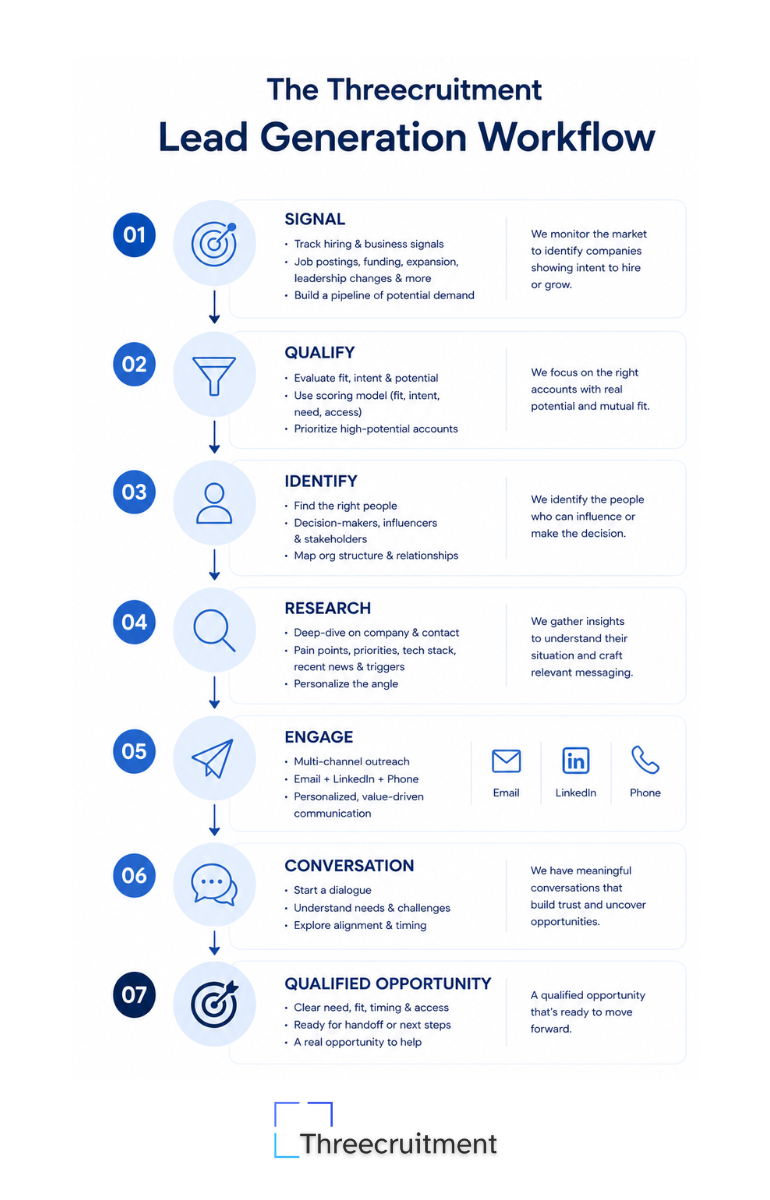
Another prospect may follow:
Google search → specialist guide → service page → case study → enquiry → qualification call.
A third might follow:
Candidate introduction → hiring conversation → vacancy → proposal.
Lead generation becomes more predictable when these journeys are designed intentionally.
Example Outbound Workflow
Day 1: Identify a hiring signal and qualify the account.
Day 1: Research the likely decision-maker and record why the account is relevant.
Day 2: Send a short, trigger-based email.
Day 3–4: Review appropriate LinkedIn activity and engage genuinely where relevant.
Day 4: Call.
Day 7: Send a follow-up containing useful market information.
Day 12: Call or email again with a different angle.
Day 20+: Move the prospect into appropriate nurture or signal monitoring if there is no active opportunity.
Do not treat these timings as universal rules. Test cadence against your market, buyer seniority and applicable communication rules.
CRM Discipline Matters
Every meaningful account should have structured fields for:
- industry;
- employee size;
- specialization;
- account tier;
- lead source;
- hiring signals;
- decision-makers;
- last contact;
- next action;
- opportunity stage;
- estimated value;
- lost reason.
Without reliable CRM data, agencies often mistake activity for pipeline.
15. Measure the Right Recruitment Lead Generation KPIs
Do not optimize solely for emails sent, calls made or LinkedIn connections.
Those are activity metrics.
Track the funnel.
Prospecting Metrics
Measure:
- target accounts researched;
- decision-makers identified;
- contacts reached;
- positive response rate;
- conversations created;
- meetings booked.
Open rates can be directionally useful in some systems but should not be treated as perfectly reliable because email privacy features can distort them.
Pipeline Metrics
Track:
- qualified opportunities;
- vacancies received;
- proposals or terms sent;
- new clients won;
- average sales cycle;
- pipeline value;
- source-to-client conversion.
Revenue Metrics
Ultimately measure:
- placements by lead source;
- revenue by channel;
- gross profit by channel;
- customer acquisition cost where measurable;
- repeat business;
- client lifetime value;
- revenue per target account.
Diagnose the Funnel
If meetings are high but vacancies are low, qualification or sales conversations may be weak.
If replies are low, targeting, messaging or deliverability may be the problem.
If traffic is high but enquiries are low, landing-page intent or conversion may be weak.
If enquiries are high but few become clients, lead quality may be the issue.
Good measurement tells you where the system breaks.
16. Recruitment Agency Lead Generation Mistakes to Avoid
Buying Huge Lists and Blasting Them
Database size is not market penetration.
Poor targeting increases wasted effort and can create deliverability, reputation and compliance problems.
Leading With “We Have Great Candidates”
Every recruitment agency says it has great candidates.
Explain why your candidate network is relevant to the buyer’s actual hiring challenge.
Automating Before You Have a Working Message
Automation scales outcomes.
If your targeting and messaging are weak, it scales poor outcomes faster.
Validate campaigns manually before expanding them.
Contacting Only HR
Depending on the organization, the commercial opportunity may originate with a CTO, engineering director, sales leader, CFO, founder or operational manager.
Map the organization.
Relying Entirely on Job Advertisements
By the time a vacancy appears publicly, the employer may already have:
- internal candidates;
- existing suppliers;
- direct sourcing underway;
- referrals;
- applications arriving.
Use job advertisements as one signal among many.
Publishing Generic SEO Content
“10 Interview Tips” may attract candidates rather than employers.
Client-focused SEO should align with employer problems.
Giving Up After One Touch
B2B timing is unpredictable.
A prospect may like your agency but have no need this month.
Build respectful follow-up and nurture processes so you remain discoverable when demand appears.
17. A Practical 90-Day Lead Generation Plan for Recruitment Agencies
If your agency currently depends on ad hoc business development, do not attempt 20 channels simultaneously.
Build the foundation first.
Days 1–30: Define and Build
Week 1: Define the market
Document:
- niche;
- ICP;
- buyer roles;
- strongest services;
- common client problems;
- geographic focus;
- disqualification criteria.
Week 2: Build your account list
Create an initial target universe.
Score accounts according to fit.
Identify 50–100 priority organizations for deeper research.
Week 3: Build signals
Choose five to ten signals to monitor, such as:
- new vacancies;
- repeat vacancies;
- funding;
- senior appointments;
- expansion;
- previous client activity.
Week 4: Fix infrastructure
Review:
- CRM fields;
- email authentication;
- website conversion paths;
- employer landing pages;
- LinkedIn profiles;
- analytics;
- lead-source tracking.
Days 31–60: Launch
Run small outbound campaigns rather than massive blasts.
For example, create three segments:
- SaaS companies advertising multiple engineering positions.
- Previous clients that have restarted hiring.
- Target companies with recently appointed technical leaders.
Write a separate proposition for each.
At the same time:
- publish one strong employer-focused article weekly or at a sustainable cadence;
- post useful market insights on LinkedIn;
- begin referral conversations;
- call priority accounts;
- update commercial service pages.
Review results weekly.
Days 61–90: Optimize
Now compare:
- which signals generate conversations;
- which segments generate meetings;
- which messages create positive responses;
- which channels generate vacancies;
- which pages attract employer traffic;
- which recruiters convert conversations best.
Stop low-quality activities.
Increase investment in what creates qualified pipeline.
Then document the process as a repeatable playbook.
Recruitment Agency Lead Generation Checklist
Use this checklist before scaling your strategy:
- Define a narrow ICP.
- Document client pain points.
- Build a scored target-account list.
- Identify relevant hiring signals.
- Map several decision-makers for major accounts.
- Configure email authentication and deliverability monitoring.
- Segment outbound campaigns.
- Build trigger-based email messages.
- Create a calling workflow.
- Optimize recruiter LinkedIn profiles.
- Publish employer-focused content.
- Build specialist SEO landing pages.
- Develop referral processes.
- Use candidates intelligently for business development.
- Add account tiers.
- Track every opportunity in the CRM.
- Measure positive responses rather than vanity metrics alone.
- Measure vacancies and revenue by source.
- Use AI for research and productivity, not unchecked mass personalization.
- Review compliance in every market where you prospect.
- Optimize the system monthly.
Want this system built for your agency?
Frequently Asked Questions About Lead Generation for Recruitment Agencies
What is the best lead generation strategy for recruitment agencies?
There is no single channel that is best for every agency. A strong 2026 strategy combines a tightly defined ideal client profile with hiring-intent signals, personalized outbound email, phone outreach, LinkedIn, referrals, SEO and useful employer content.
The key is integration. Use signals to determine who to contact, outbound channels to create conversations, and inbound assets to build trust when prospects research your agency.
How do recruitment agencies find new clients?
Recruitment agencies can find clients through job and hiring signals, referrals, former candidates, LinkedIn, cold email, phone prospecting, industry events, partnerships, SEO, content marketing, paid search and existing networks.
The strongest prospects normally combine a good ICP fit with evidence of a current or emerging hiring requirement.
Does cold email still work for recruitment agencies in 2026?
Cold email can still generate recruitment leads when it is targeted, relevant, compliant and supported by good deliverability practices.
High-volume generic messages are increasingly difficult to justify strategically because decision-makers receive substantial automated outreach. Agencies should prioritize segmentation, real business triggers and credible relevance rather than superficial AI personalization.
How can recruitment agencies generate leads on LinkedIn?
Recruitment agencies can use LinkedIn to identify decision-makers, follow target accounts, monitor hiring signals, demonstrate specialist expertise and build professional relationships.
Recruiters should optimize their personal profiles around a clear niche and publish content useful to employers. Avoid unauthorized scraping or automation that violates LinkedIn’s platform rules.
What content should a recruitment agency create to attract clients?
Prioritize employer-focused content such as salary guides, hiring benchmarks, skills-shortage analysis, market reports, role-specific hiring guides, compensation data, interview guidance, case studies and recruitment strategy comparisons.
Choose topics based on questions hiring managers ask before selecting an agency.
Should recruitment agencies buy lead lists?
Purchased business data may sometimes support prospect research where lawful and appropriate, but buying a large list and sending generic campaigns is rarely a strong strategy.
Data should be validated, segmented and assessed for lawful use. The commercial objective should be identifying relevant accounts rather than maximizing contact volume.
How can a recruitment agency use AI for lead generation?
AI can accelerate account research, company summaries, signal analysis, CRM administration, content repurposing, campaign analysis and first-draft personalization.
Human review remains important. AI-generated facts and personalization can be wrong, and fully automated messaging often misses the contextual understanding that makes recruitment outreach persuasive.
What is intent-based recruitment lead generation?
Intent-based lead generation prioritizes companies showing evidence that they may need recruitment services.
Signals can include new job advertisements, repeated vacancies, funding, expansion, senior leadership changes, major contracts, new locations and engagement with your agency’s website or content.
How many times should a recruiter follow up with a prospect?
There is no universal number. The appropriate cadence depends on market, channel, buyer role, engagement and applicable communication rules.
A practical sequence can combine several touches across email, telephone and professional social channels rather than repeatedly sending variations of the same email. Stop or change approach when the prospect opts out, clearly declines, or continuing contact is otherwise inappropriate.
How long does recruitment agency lead generation take?
Outbound campaigns can generate conversations relatively quickly, while SEO, content and referral ecosystems generally require longer-term investment.
A balanced agency should therefore maintain short-term prospecting while building inbound assets that compound over time.
What KPIs should recruitment agencies track?
Useful metrics include positive response rate, conversations, meetings, qualified opportunities, vacancies generated, proposals, new clients, pipeline value, placements, revenue by source, acquisition cost and repeat business.
Avoid evaluating business development solely by calls, emails, impressions or connections.
Is SEO worth it for recruitment agencies?
SEO can be valuable when an agency specializes in markets employers actively research online.
Commercial landing pages can capture buyers searching for agencies, while informational content can reach employers researching salaries, skills shortages, hiring processes and difficult-to-fill roles earlier in their buying journey.
What is the difference between recruitment lead generation and candidate sourcing?
Recruitment lead generation finds potential clients that may pay for recruitment services. Candidate sourcing finds people who may fill vacancies.
The activities overlap because candidates can become clients, and candidate-market intelligence can create employer conversations, but they have different commercial objectives.
How much should a recruitment agency automate?
Automate repetitive internal processes before automating relationship-building.
Good candidates for automation include alerts, CRM updates, task creation, reporting, data classification and first-pass research. High-value outreach, qualification and sales conversations generally benefit from human judgment.
Can recruitment agencies outsource lead generation?
Sure, just make sure you are partnering up who has deep understanding of recruitment industry, especially difference between agency and in-house side.
Threecruitment specializes in client acquisition and lead generation systems specifically for recruitment agencies.
Conclusion
Lead generation for recruitment agencies in 2026 is moving away from the idea that more contacts automatically produce more clients.
The agencies with the strongest systems focus on relevance, timing, expertise and disciplined execution.
Define exactly which organizations you can help. Monitor the signals that indicate when those organizations are likely to hire. Use AI to reduce research and administrative work without outsourcing judgment. Combine email, calls, LinkedIn and referrals for proactive demand generation. Build specialist SEO pages, authoritative content and a clear digital presence so employers can discover and evaluate you independently.
Most importantly, connect everything to revenue.
A database is not pipeline.
An email sent is not a lead.
A LinkedIn connection is not an opportunity.
A qualified employer with the right problem, at the right time, who trusts your ability to solve it, that is the outcome your recruitment lead generation system should be designed to create.

Author
Edmond Široka
Founder @ Threecruitment
Edmond has spent more than a decade working across recruitment, HR, sales and business development. His experience includes agency recruitment, in-house talent acquisition, HR leadership and running a recruitment business. Today, he focuses on building practical client acquisition systems for recruitment agencies.